Can AI Coding Tools Build Your PIM?
.svg)
Your engineering team already has AI coding tools that can spin up a working application in an afternoon. So when the topic of a governed product data platform comes up, someone on the leadership team asks the obvious question: why buy one when a developer with Claude Code, or a tool like it, could just build it?
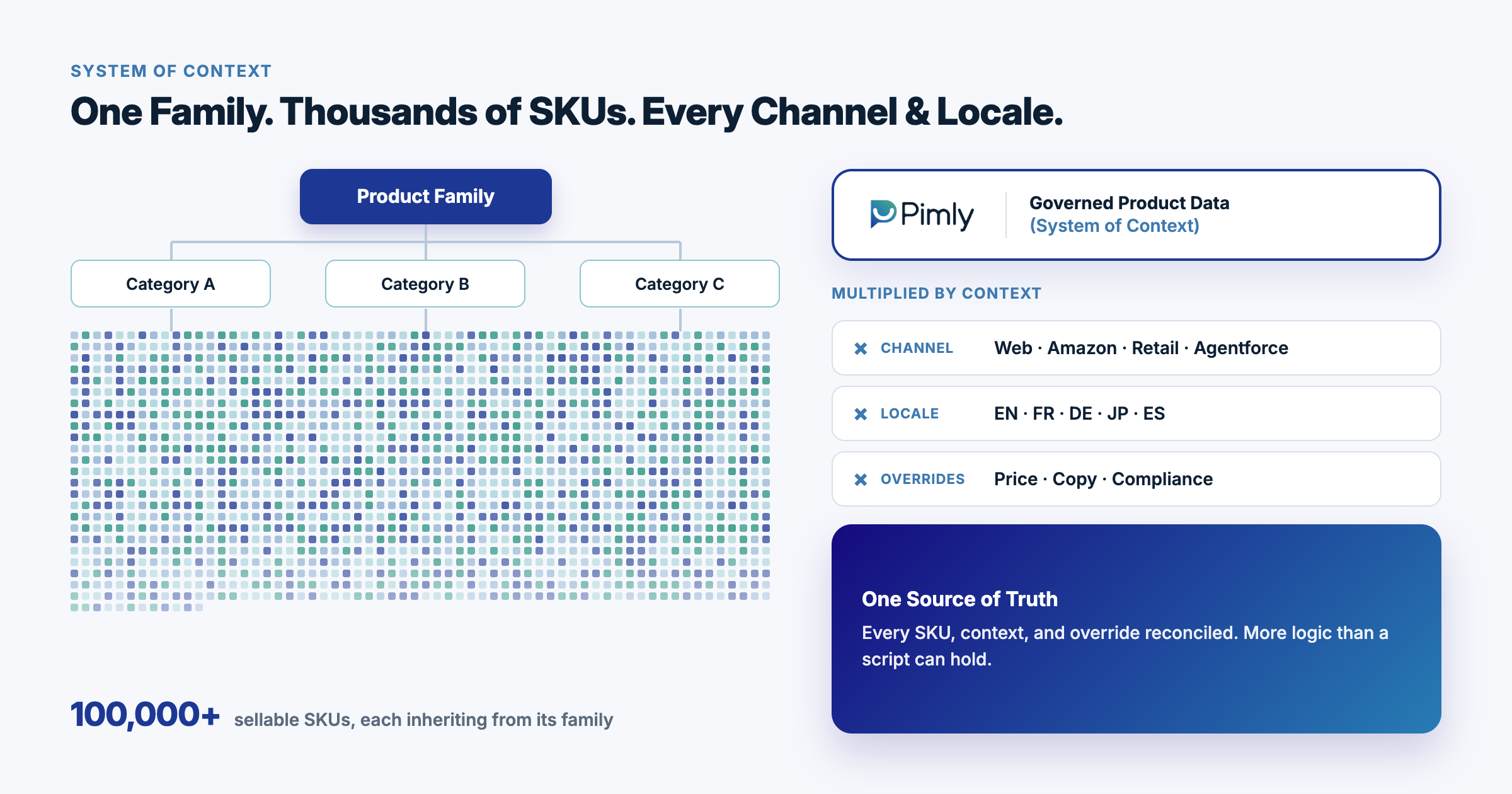
The answer starts with what a PIM has to do for an organization. A product information management platform is a hierarchical data model: product families with parent and child records, inheritance rules that push a value down to every SKU beneath it, and channel and locale overrides that change the correct answer depending on where and how the product is being sold. A PIM is not just a system of record; it's a system of context in which the right answer varies according to the specific context in which a question is being asked. That data structure is what makes an AI agent's answer reliable instead of a guess. The system of context tells an AI agent which answer is right for this customer, in this channel, in this market, because the same product question can have two different correct answers depending on where it's asked.
Here's where the AI-built version breaks. A developer uses an AI coding tool to stand up something that looks like a PIM in a few weeks: product records, a few fields, a simple hierarchy. It handles the demo fine. Then a sales rep asks whether a part is compatible with a configuration sold only in one region, or a service agent needs to know which warranty terms apply in a channel the tool was never built to distinguish, and the system has no way to know the difference. Nobody designed for that case, because designing for it was never the fast part. It's the same reason a self-assessment of AI readiness almost always turns up gaps a demo never would.
This matters most for the IT leaders and CIOs at manufacturers currently weighing whether AI coding tools have made buying enterprise software optional.
Key takeaways
- Sales reps, service agents, and AI agents get product answers that are correct for the channel and customer they're serving, because a governed data model resolves the context.
- Writing code got fast and cheap. Governing a hierarchical product data model at enterprise scale, with families, inheritance, channels, and locales, and then using AI to reliably leverage that information to respond to questions and take appropriate actions remains the work of purpose-built product information management software.
- Analysts are drawing a hard line between building software and operating it, and that distinction is exactly why enterprise platforms are proving resilient to AI disruption.
See what a governed system of context looks like inside your own Salesforce org. Book a demo and bring your hardest product question.
Why "just have a developer build it" misses the point
A Wall Street Journal analysis this fall captured why the feared wave of AI-driven software disruption has moved slower than investors expected. Salesforce and other enterprise vendors took a real hit earlier in the year on fears that AI coding tools would let companies simply build cheaper replacements in house. Then Salesforce beat expectations, raised its outlook, and announced an expanded partnership bringing Claude into its own platform, and the stock jumped roughly 20%.
The article's central distinction explains why. Gartner analyst Arun Chandrasekaran drew a clean line between building software and operating it. AI has made writing new code fast and cheap. It has not made maintaining that code, integrating it with everything else a business runs on, securing it, and adapting it as requirements change, fast or cheap. Those are two different jobs, and enterprise software vendors were never really selling code. They were selling the second job.
That's the same reason large enterprises haven't rebuilt Salesforce, ServiceNow, or Workday from scratch just because a coding assistant made the first draft easy. Replacing a platform an entire business runs on means taking on its operating burden yourself, and that's an unattractive trade for a company whose job is not software engineering. The same logic applies to the product data layer those platforms depend on.
What a system of context requires
Picture a manufacturer selling the same product line through two channels: a direct enterprise sales motion and a regional distributor network. A sales rep in the direct channel and a partner in the distributor channel can ask what looks like the identical question about the same SKU, and the correct answer is different for each of them, because eligibility, configuration options, or compliance requirements vary by channel and by market.
An AI coding tool has no way to resolve that on its own. It can write the code that stores a product record. It cannot decide, without being told, that the right answer depends on which channel is asking. That decision requires a governed hierarchy underneath the question, built on the same families, inheritance, and channel discipline that any serious product data practice runs on: product families with defined parent and child structure, inheritance so a value set once flows down to every SKU beneath it unless deliberately overridden, and channel and locale rules that change what's required or valid at each level. Build that correctly and an AI agent, whether it's Agentforce, Claude or any other tool, has a real system of context to draw from. Skip it and the agent is confidently guessing, which is worse than not answering at all.
This is also why the surface-level parts of a homegrown build always look deceptively finished. Anyone can stand up product records with a few fields, that's not the hard part. The hard part is the governance layer underneath: approvals, taxonomy, validation rules that differ by channel, and a structure disciplined enough that a hundred thousand SKUs still resolve correctly a year later. That depth is what separates real enterprise software from a working demo.
Not sure whether your own product data could support that kind of system today? Try the free Product Data Grader and get a read on your AI readiness in about a minute.
Why governed product data, not more code, is the hard part
Pimly's product data layer runs natively inside Salesforce, structured into exactly the kind of hierarchical model described above: families, inheritance, and channel and locale overrides that resolve to the correct answer automatically. That's a different job than what Salesforce's own Product2 object can do on its own, and it's not one an AI coding assistant can shortcut. Pimly SmartSync then distributes that governed catalog to the Salesforce endpoints that need it, including Agentforce Revenue Management, Agentforce Commerce, Sales Cloud, and Service Cloud, each as a configuration inside the platform you already own, not a separate project to maintain. We even use the same SmartSync technology to ship your governed, structured product catalog to Shopify.
None of that replaces the need for real software with the AI investments companies are already making. It's the opposite case. Agentforce and other AI agents become genuinely useful once they're reasoning over data that's accurate, complete, structured, and well governed enough to trust without a human checking the output first. Sales reps, service agents, ecommerce operators, marketers, and Agentforce bots all draw from the same governed record, so the question a rep asks and the question an AI agent asks resolve against the same underlying truth.
What the Salesforce and Anthropic partnership actually proves
The expanded partnership the WSJ article pointed to, bringing Claude directly into Salesforce workflows and corporate data, is worth sitting with. Claude doesn't become more valuable to Salesforce customers by replacing Salesforce. It becomes more valuable by reasoning over the trusted, governed data already inside it. That's the entire argument against building your own product data platform with an AI coding tool: the value of AI in an enterprise goes up when it operates inside a governed system, not when it's asked to reinvent one from scratch, alone, without the operating discipline that system requires.
Product data is no exception. ChatGPT, Claude, Copilot, Gemini, and Agentforce can all generate impressively confident answers about a product. Whether that answer is correct still depends on whether it's grounded in a governed record, not on which AI wrote the query.
The real risk of the lone developer
Every enterprise IT leader has walked into a version of this before: a system one person built years ago, in a tool nobody else fully understands, that quietly runs some part of the business until that person retires, quits, or gets pulled onto something else. AI coding tools make it faster to create that same situation, not slower. A single developer can now generate a working object model in days. What they can't generate in days is the years of governance decisions, approval structures, and edge case handling that a real PIM accumulates and maintains as a matter of course.
That's the actual risk profile IT leaders should be weighing: not whether a developer can produce working code, but who owns and maintains the governance logic once that developer moves on, and whether the business can afford to find out the answer is nobody. Notably, this isn't an argument for hiring more consultants either. Salesforce admins already run Pimly day to day without an outside consultant or a single developer's tribal knowledge, because the governance logic lives in the platform, not in one person's head. The bigger the company and the more product complexity involved, the more expensive that bet becomes.
The result, when the governance layer is built and maintained properly instead of improvised: every rep becomes a product expert, answering confidently, quoting accurately, and winning more deals, because the system underneath them was built to be trusted.
Would you rather confirm your product data is ready now, or find out the hard way after a developer has already tried to build around it? Try the free Product Data Grader.
Frequently asked questions
What is a system of context for product data?
A system of context is the governed data structure that lets an AI agent give the correct answer to a question whose right answer depends on circumstances like channel, market, or customer. It's built from product families, inheritance rules, and channel and locale overrides that resolve automatically to the right value. Without it, an AI agent has no way to know that the same question can have two different correct answers.
Can AI coding tools like Claude Code actually build a PIM?
An AI coding tool can generate the surface-level object model of a product database quickly, records, fields, and basic relationships. It cannot generate the governance layer that makes that data trustworthy at scale: approval workflows, validation rules that vary by channel, and inheritance logic disciplined enough to hold up across thousands of SKUs over years. That layer is built and maintained through real software, not a handful of coding sessions.
How is a governed PIM different from something an AI tool builds from scratch?
A governed PIM is built specifically to maintain accuracy as complexity grows: new channels, new locales, new product families, and new edge cases all get absorbed by a structure designed to manage that complexity. A tool an AI coding assistant helps build once is optimized for getting a working version out fast, not for staying correct as the business changes around it. The difference shows up months later, not on day one.
Why isn't a single developer with an AI coding assistant enough for enterprise product data?
A single developer can produce working code quickly, but enterprise product data requires ongoing governance decisions that outlast any one person's tenure: what gets validated, what inherits from what, and how exceptions get handled as the catalog grows. When that developer leaves, the accumulated logic usually leaves with them, and nobody left behind fully understands how the system actually works. Real PIM software is built so that knowledge lives in the platform, not in one person's head.
How does Pimly provide a system of context for Agentforce, Claude, and other AI agents?
Pimly structures product data into a hierarchical model, with families, inheritance, and channel and locale overrides, running natively inside Salesforce. SmartSync then distributes that governed catalog to Agentforce Revenue Management, Agentforce Commerce, Sales Cloud, and Service Cloud as configurations, so every AI agent and every rep draws from the same governed source. The result is an answer that's reliable for the context it was asked in, not a confident guess.