How Do You Get Your Product Catalog ARM-Ready Before Implementation Stalls?
.svg)
Your Salesforce team has scoped an Agentforce Revenue Management (ARM) rollout, and the project plan already assumes months of custom integration work to get product data flowing into it. Before signing off on that plan, ask a narrower question: does this actually require a custom integration project, or is the real gap that your product catalog isn't ARM-ready yet?
ARM-ready product data means your catalog's configurable products, bundles, and attributes are structured and governed well enough for Agentforce Revenue Management (ARM) to quote from them without a person correcting the output afterward. B2B manufacturers reduce quoting errors in Agentforce Revenue Management by giving it one governed record — not a Product2 object patched together from spreadsheets, a PLM export, and a compliance spec nobody updated since the last engineering change.
Here's where it actually stalls: a Salesforce admin scoping the rollout tells the implementation partner "ARM scoping is slipping on product data" — the bundle logic doesn't match what's in the ERP, half the configurable SKUs are missing compatibility rules, and nobody owns the readiness call. The project timeline quietly slides from a quarter to two.
If you're the VP of RevOps sponsoring this initiative, or the Salesforce admin or IT lead who has to actually build the connection, this is the practical path forward: what "ARM-ready" requires technically, how long it really takes to get there, and where a custom integration project costs you time and budget that a native approach doesn't.
Key takeaways
- Every quote a rep sends from Agentforce Revenue Management (ARM) is built on one governed product record — no more chasing down the right spec before a deal closes.
- "ARM-ready" has four specific technical requirements: configurable product structures, bundle relationships, multi-attribute modeling, and a governance/readiness score — not just "the data is clean."
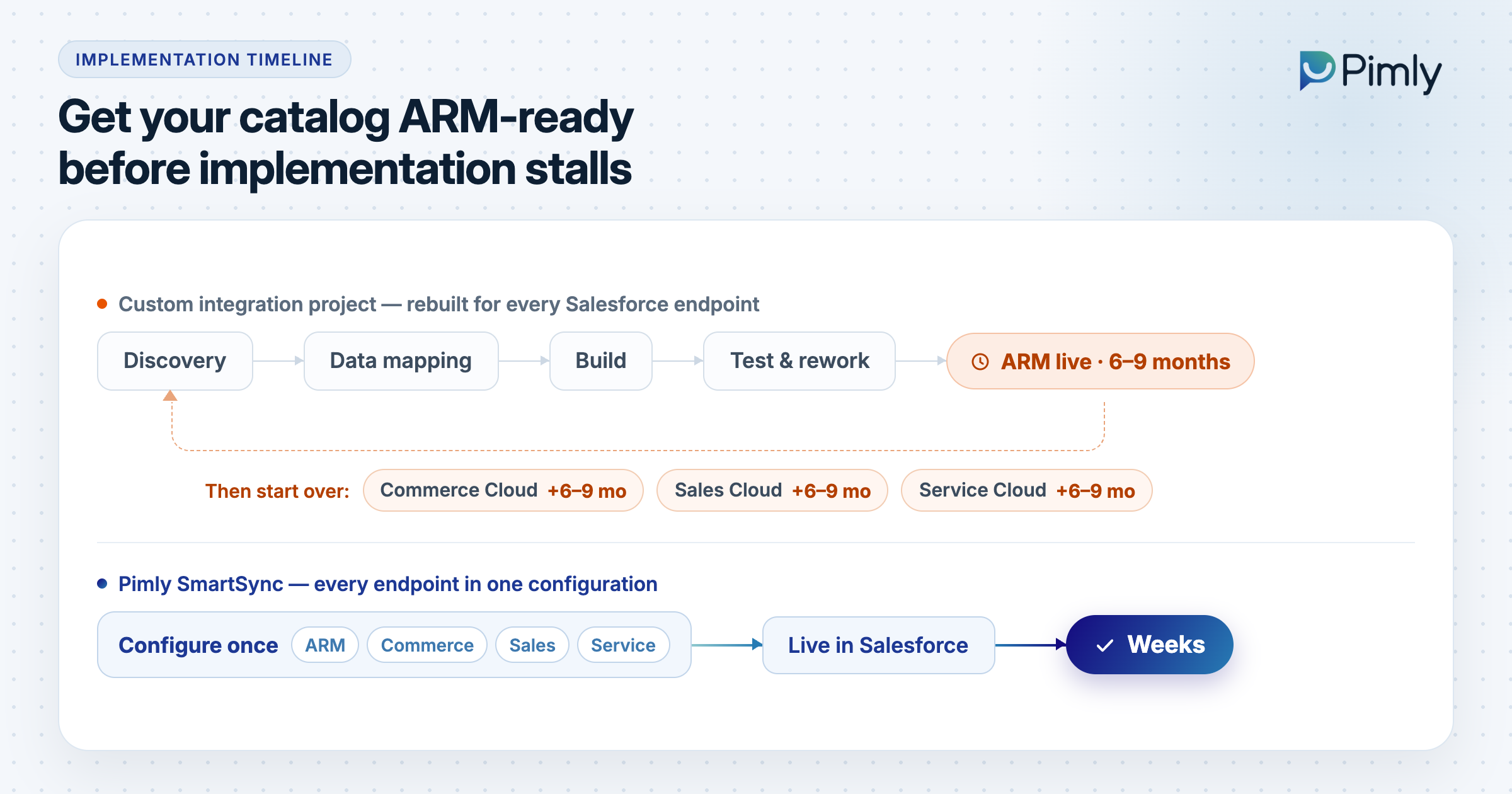
- A custom integration project to get a catalog ARM-ready typically runs 6-9 months; Pimly's SmartSync does the same work as configurations inside Salesforce, live in weeks.
- W.S. Darley & Co reached full payback on its Pimly investment in 9 months — a useful benchmark for how fast a governed catalog pays for itself.
- SmartSync eliminates the need for a new custom integration project every time you add a Salesforce endpoint — ARM today, Commerce, Sales, Service & Agentforce next.
Try our Free Product Data Grader to see how ARM-ready your catalog is today.
What does "ARM-ready" actually mean for your product catalog?
Agentforce Revenue Management (ARM) is Salesforce's quote-to-cash engine — it automates configuration, pricing, and quoting once it has a product record to work from. It doesn't create that record or fix one that's incomplete. That's the gap most ARM rollouts hit: the platform is ready before the data is.
Getting a catalog ARM-ready means clearing four specific technical requirements, not just running a data-cleanup pass:
- Configurable product structures — variant logic that reflects how a product is actually built and sold, not a flat SKU list.
- Bundle relationships — which components ship together, which are optional, and which combinations are invalid, modeled explicitly rather than tracked in a rep's head.
- Multi-attribute modeling — the specs, tolerances, and compliance metadata that determine whether a configuration is even valid, attached at the attribute level rather than buried in a document.
- A governance and readiness score — a defined owner for every attribute, plus a way to measure whether the catalog is actually ready before rollout, not just assumed to be.
That fourth point is where compliance documentation usually breaks down: a component's certification often exists as a supplier PDF, not a searchable field. Pimly's Asset Intelligence scans documents like these and vectorizes them, so a compliance attribute buried in a PDF becomes part of the same governed, queryable record ARM depends on — not a manual lookup a rep has to do outside Salesforce.
B2B manufacturers reduce quoting errors in Agentforce Revenue Management by governing product data to this standard before rollout, not by tuning ARM's automation after errors start showing up. For the deeper technical checklist, see our breakdown of what AI-ready product data actually requires.
Why does ARM scoping stall on product data?
"ARM scoping is slipping on product data" is a phrase implementation partners hear often enough that it should be a planning input, not a mid-project surprise. It shows up the same way almost every time: discovery surfaces that configurable SKUs live partly in Product2, partly in an ERP, and partly in a PLM system, and none of the three agree on bundle rules or compatibility logic.
A mid-market or enterprise manufacturer managing 500+ configurable SKUs hits this wall most often, because the complexity that makes ARM valuable — deep configuration options, multi-part bundles, regulated components — is the same complexity that makes the data hard to govern manually. Our 8-point Agentforce readiness check for B2B manufacturers walks through the specific signals a catalog isn't ready, before that gap turns into slipped scope.
The fix isn't more QA on the ARM configuration itself — it's resolving where the governed product record lives before ARM ever queries it.
If the scoping conversation keeps circling back to "the data's in the ERP," here's why an ERP alone can't feed your reps and service agents — and what closes that gap.
See what an ARM-ready product catalog looks like inside your own Salesforce org — book a demo.
Custom integration project vs. SmartSync: what's the real Salesforce implementation cost?
Once a team identifies the gap, the plan usually defaults to a custom integration project: build a connector between the PIM or ERP and Salesforce, map every field, and test every endpoint. For a catalog with real configuration complexity, that's typically a 6-9 month build — and every dollar of it is Salesforce implementation cost that shows up before ARM ever quotes a real deal.
Pimly runs natively on Salesforce, so getting a catalog ARM-ready doesn't require an integration project at all. Product data lives inside the same platform ARM already queries, and reaching a new Salesforce endpoint — ARM, Agentforce Commerce, Sales Cloud, Service Cloud, or Agentforce itself — is a configuration inside Pimly via SmartSync, not a new integration your IT team has to design, build, and support. See our guide to choosing a Salesforce-native PIM for the specific criteria that separate a native connection from an integrated one. We even use the same SmartSync technology to ship your governed, structured product catalog to Shopify.
That distinction is also where the ongoing cost lives: an external PIM's connection to ARM is an integration that breaks when either system changes, while SmartSync is reserved for Pimly's own native connection, with no separate integration layer to maintain every time ARM changes underneath it. Manufacturers evaluating Pimly against a custom build typically see the first wave of SKUs live inside ARM within weeks, not the two full quarters a custom integration project usually needs before it's even tested.
How does a governed product catalog pay for itself?
Darley's 9-month payback
Darley evaluated the field before choosing Pimly and reached full payback on that investment in 9 months — a useful benchmark for how fast a governed data foundation pays for itself when it's feeding a revenue-critical system like ARM, not a multi-year initiative competing for the same budget as the rollout itself. That payback curve is the case for treating catalog readiness as part of the ARM project's scope and budget from day one, not a cleanup effort after go-live.
That same budget argument extends beyond ARM. For the version a CIO makes to peer leaders and then to the CFO and board, see how a CIO makes an AI rollout succeed.
What does day one look like when your catalog is already ARM-ready?
The teams that avoid the "ARM scoping is slipping" conversation are the ones that treat product data as part of the ARM project plan, not an assumption underneath it — resolving configurable structures, bundle relationships, multi-attribute modeling, and governance ownership as configurations inside Pimly, not as a parallel integration workstream competing for the same engineering time as the ARM build itself.
If the bigger question on your side is when to invest in product data at all — before ARM and Commerce go live, or after they already have — that sequencing decision is its own conversation: should you fix your product data before or after CPQ and Commerce go live?
The result: every rep becomes a product expert — answering confidently, quoting accurately, and winning more deals.
Would you like Pimly to help you assess how ARM-ready your own product catalog is? Try the free grader.
Frequently asked questions
What does "ARM-ready" mean for a product catalog?
"ARM-ready" means a product catalog is structured and governed well enough for Agentforce Revenue Management to quote from it without a person correcting the output afterward. It requires four specific things: configurable product structures, explicit bundle relationships, multi-attribute modeling for specs and compliance data, and a governance and readiness score with a defined owner. A catalog can look "clean" in a spot check and still fail this bar if those four elements aren't in place before rollout.
How long does it take to get a product catalog ARM-ready?
A custom integration project to connect an external PIM or ERP to Salesforce for ARM typically takes 6-9 months, including discovery, field mapping, and testing across every endpoint. Pimly runs natively on Salesforce, so the equivalent work happens as configurations inside Pimly via SmartSync, with the first wave of SKUs typically live within weeks. The difference in timeline is also a difference in Salesforce implementation cost, since a custom integration carries build and ongoing maintenance cost a native configuration doesn't.
How is getting ARM-ready different from a general PIM implementation?
A general PIM implementation asks whether a catalog is complex enough to justify a product information system at all — SKU count, attribute count, channel count. Getting ARM-ready asks a narrower, higher-stakes question: can Agentforce Revenue Management quote a real configuration today without a human correcting it. A catalog can pass a general PIM evaluation and still fail this test if bundle relationships and governance ownership haven't caught up to what ARM specifically requires.
Why isn't a custom integration project the right approach for ARM readiness?
A custom integration project treats product data readiness as a one-time technical build rather than an ongoing governed record, so it's expensive to stand up and just as expensive to maintain every time ARM, Sales Cloud, or Service Cloud changes underneath it. It also typically moves over only the subset of product data the original build scoped for, which means new configuration rules or compliance attributes require another round of engineering work later. A native configuration avoids both problems because there's no separate integration layer to rebuild or maintain.
How does Pimly make a product catalog ARM-ready without a custom integration project?
Pimly runs natively inside Salesforce, so product data lives in the same platform ARM already queries instead of a disconnected system feeding it through an integration. The process is three steps: pull data in from ERP, PLM, spreadsheets, and every other scattered source; organize it into one governed record with configurable structures, bundle relationships, and multi-attribute modeling; then distribute it via SmartSync to ARM, Commerce, Sales Cloud, and Service Cloud as configurations, not integration projects. Manufacturers evaluating Pimly typically see their first governed SKUs live inside ARM within weeks of starting.