What Can Pimly Do That Salesforce Product2 Cannot?
.svg)
If your product records already live in Salesforce's native Product2 object, a fair question follows: do you actually need a PIM on top of it, or is that just another system to buy and maintain?
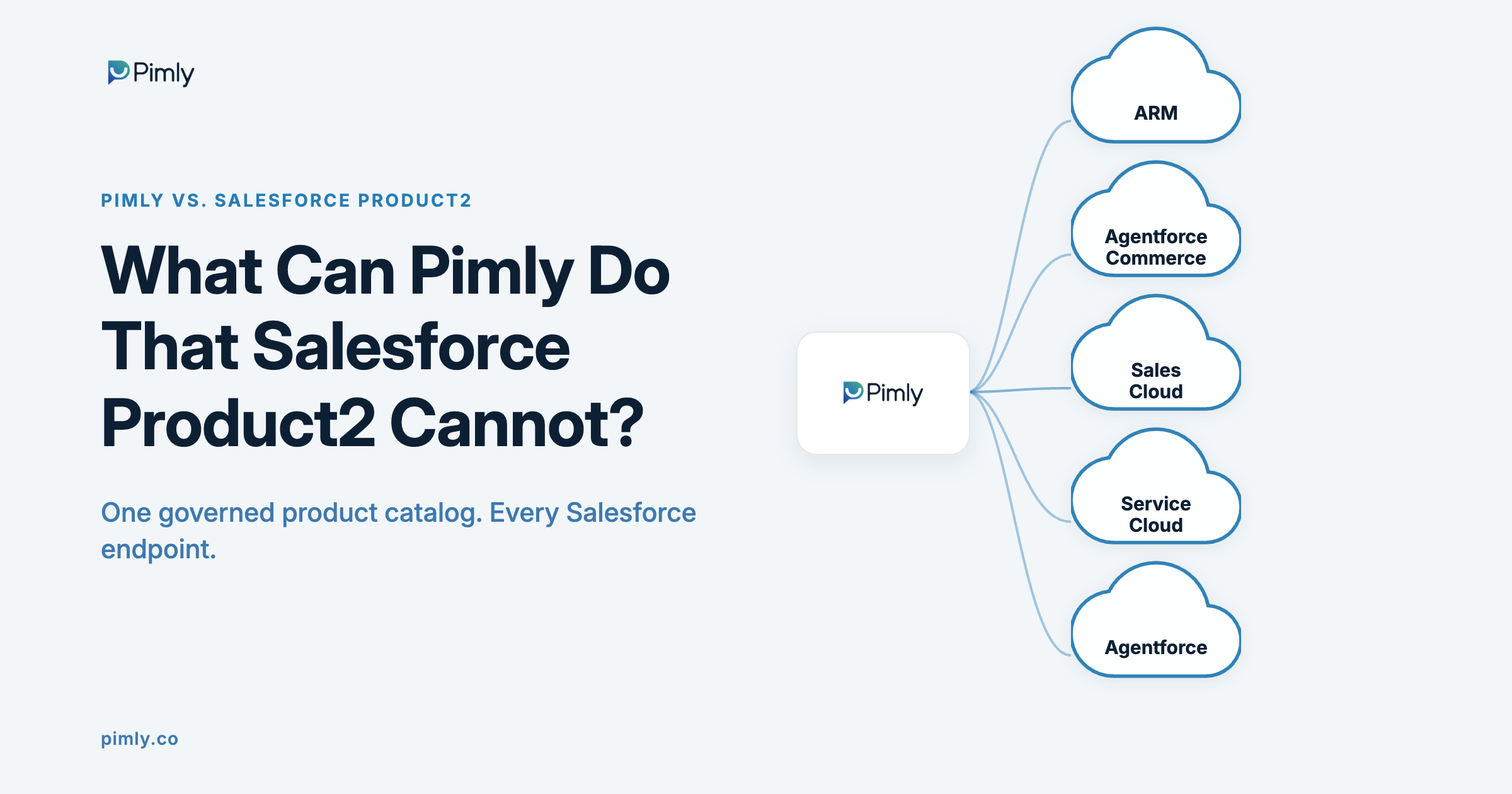
Product2 is Salesforce's built-in product record — it stores a SKU, a name, a price book entry, and a handful of custom fields. That's workable for a short list of simple products. It breaks down fast once a manufacturer is managing several hundred SKUs or more, or selling products with configurations and bundles — and that breakdown happens inside Sales Cloud, Service Cloud, Agentforce Revenue Management (ARM) or Agentforce Commerce. Pimly is a Salesforce-native product intelligence layer that governs that same catalog with the hierarchy, digital assets, and AI-readiness Product2 was never built to carry, then delivers it to every Salesforce cloud your reps, service agents, and AI agents actually use.
The short answer: for manufacturers with real SKU volume or configurable, bundled products, Product2's flat record isn't enough for the reps and service agents working inside Sales Cloud and Service Cloud every day — they need the digital assets and hierarchical context Product2 doesn't carry to quote the right parts, answer customer questions, and close cases. Pimly governs and delivers that same catalog everywhere it's needed, including feeding ARM and Agentforce Commerce a governed, structured version to quote and sell from. Master Product Data Management With Product Intelligence covers Product2's structural limits in depth; this piece answers the sharper question — can your reps quote confidently, can your service agents close a case without a callback, and can that catalog reach every Salesforce cloud without a rebuild each time something changes?
Here's a scene most Salesforce Admins and Product Data Managers know well: Product2 has three custom fields, a picklist that was supposed to be temporary two years ago, and a spreadsheet a product manager keeps "just in case" because half the digital assets never made it into the org. A sales rep can't find the spec sheet for a configuration mid-call, so they quote from the spreadsheet instead — and sometimes quote the wrong bundle. A service agent can't see which parts are compatible with which assembly, so they call IT for the PDF. None of that requires ARM or Agentforce Commerce to be in the picture — it's already a problem inside Sales Cloud and Service Cloud, the moment the catalog has any real size or complexity to it. And if your team is considering adding Agentforce Revenue Management, you already know it will require a custom implementation to populate that product catalog correctly — Product2 alone won't get you there either.
If you're evaluating whether Pimly is worth adding to a Salesforce org that already has Product2, this is written for you — VP Sales Ops, VP Service, IT Director, Salesforce Admin, Product Data Manager — the people who own the answer to "do we need this."
Key takeaways
- For manufacturers with several hundred or more SKUs, or with configurable products and bundles, Product2's flat record falls short inside Sales Cloud, Service Cloud, Agentforce Revenue Management (ARM) and Agentforce Commerce — because sales reps, service agents and AI agents need digital assets and hierarchical context Product2 doesn't provide.
- Pimly attaches images, spec sheets, and manuals directly to a governed, hierarchical catalog showing related products, configurations, and bundles, then distributes it to Sales Cloud, Service Cloud, ARM, and Agentforce Commerce through SmartSync as configurations — not integration projects. Pimly can even distribute your product catalog to Shopify via this same SmartSync feature.
- Reps quote from one governed catalog instead of chasing a spreadsheet, and service agents get accurate answers on the first question — not after a callback to the product team.
- Product2 has no readiness reporting, no digital asset management, and no AI-readiness layer on its own; Pimly adds all three, and Pimly Product Intelligence turns the governed catalog into accurate answers for every team member — without requiring you to leave Salesforce.
Not sure where your own catalog stands against this? Try the free Product Data Grader for a quick read on your AI-readiness.
Why does Product2 fall short inside Sales Cloud and Service Cloud, not just in ARM and Agentforce Commerce?
It's tempting to read a comparison like this one and assume Product2 is fine as long as reps and service agents are only working inside Sales Cloud and Service Cloud, and the real gap only shows up once ARM or Agentforce Commerce enter the picture. That's not what we see with manufacturers running real SKU volume or configurable, bundled products.
Product2's flat record works fine for a short list of simple products — one SKU, one price, one description. It stops working once either of two things is true: the catalog has several hundred SKUs or more, or the products are configurable, bundled, or built around meaningful variants. At that point, a flat record can't hold what a rep or service agent actually needs to do the job.
Two gaps show up immediately. First, digital assets: reps and service agents need images, spec sheets, and PDF manuals to quote a part or close a case, and Product2 has no native place to attach them — they live in a shared drive, an email thread, or a spreadsheet a product manager maintains on the side. Second, hierarchy: a rep quoting a configurable product needs to see the related products, valid configurations, and bundle options in context; a service agent troubleshooting a case needs to see which parts are compatible with which assembly. Product2's flat, one-row-per-product structure has no way to represent any of that.
The result is a rep who can't confidently answer whether a configuration works with a given assembly, a service agent who escalates a case a governed catalog would have let them close on the first call, and a missed upsell or cross-sell because nobody could see the related product sitting one click away. Pimly's governed, hierarchical catalog and centralized digital asset management close both gaps directly inside Sales Cloud and Service Cloud, before ARM or Commerce ever enter the picture.
How does Pimly compare to Salesforce Product2?
Product2 and Pimly aren't solving the same problem — here's where each one actually stands:
| Dimension | Salesforce Product2 | Pimly |
|---|---|---|
| Scale & complexity ceiling | Fine for a short list of simple products; breaks down once a catalog passes a few hundred SKUs or includes configurable, bundled products — in any Salesforce cloud it's used in | Built to govern thousands or even hundreds of thousands of SKUs and configurable, bundled products across Salesforce clouds without the model breaking down |
| Core structure | A flat record — one row per product, limited custom fields, no native parent-child hierarchy, no way to represent configurations or bundles | Governed, hierarchical product model with catalogs, product lines, and inheritance built for thousands of SKUs |
| Digital assets | No native digital asset management — images, spec sheets, and manuals live outside the record | Centralized digital asset management attached directly to the governed product record |
| Data sources | Whatever gets manually entered or imported into Product2 | Aggregates and governs data from ERP, PLM, spreadsheets, and other sources into one Salesforce-native model |
| Distribution | Lives inside whichever cloud it's entered into; no built-in path to reach other Salesforce endpoints on its own | SmartSync distributes the governed catalog to Sales Cloud, Service Cloud, Agentforce Revenue Management (ARM), and Agentforce Commerce as configurations |
| AI readiness | No structured layer for AI agents to draw from beyond raw field values | Pimly Product Intelligence turns the governed record into accurate, grounded answers for Agentforce and other AI agents |
| Readiness reporting | No completeness or accuracy scoring | Readiness reporting shows which products are actually ready to quote, sell, or publish |
| Primary users | Whoever enters or edits records directly in Salesforce | Sales reps, service agents, ecommerce operators, marketers, and Agentforce bots, each working from the same governed data |
Product2 isn't broken — it does what a native CRM record is built to do. The gap shows up at scale, once a catalog passes a few hundred SKUs or includes configurable, bundled products — inside Sales Cloud and Service Cloud just as much as in ARM or Agentforce Commerce.
The same logic applies one system upstream: if your answer to the gap is "the rest of the data lives in the ERP," here's why an ERP isn't enough for sales and service teams either.
Curious how your own catalog would score against this? Run it through the free Product Data Grader and see where the gaps are.
Why does the gap get worse with Agentforce Revenue Management and Agentforce Commerce?
ARM and Agentforce Commerce both quote and sell directly from the data underneath them — if that data isn't complete, structured, and current, the quote is wrong before a rep sees it.
ARM has its own product catalog and is more capable than Product2 — but it still has a ceiling for complex manufacturers managing configurable products, bundles, and variant-heavy catalogs. Incomplete governed data feeding ARM means pricing errors, configuration mistakes, and quote rework — and reps falling back on spreadsheets or tribal knowledge. Pimly SmartSync gives ARM the current, accurate product and configuration data it needs to quote correctly; pricing rules and rates stay managed in ARM itself.
The same problem shows up on the commerce side: Agentforce Commerce sells from whatever catalog data reaches it, and a partial catalog means an incomplete storefront customers can see. Pimly surfaces the full governed catalog to Agentforce Commerce the same way it does to ARM — no rebuild, just a configuration setting inside the platform you already run. We even use the same SmartSync technology to ship your governed, structured product catalog to Shopify — a lot of manufacturers on Salesforce still sell through Shopify storefronts, and that catalog doesn't have to live twice.
This is the same pattern we just saw inside Sales Cloud and Service Cloud, just at higher stakes — once ARM, Agentforce Commerce, or an AI agent needs more than Product2 was built to hold, the flat record becomes the bottleneck. Agentforce Revenue Management: What It Does (and Doesn't Do) covers ARM's own catalog limits if you're scoping an ARM rollout specifically.
What does an AI-ready answer require?
Reps and service agents don't ask Salesforce for a record — they ask a question. "Is this part compatible with that assembly?" "Why did this quote change?" "What's the lead time on this configuration?" Product2 can return a field value. It can't answer a question — that requires context Product2 was never structured to hold.
Pimly Product Intelligence is the layer that makes that possible: it takes the governed, hierarchical catalog Pimly maintains and turns it into accurate answers grounded in your actual product data, for sales reps, service agents, ecommerce operators, marketers, and Agentforce bots alike. That's a different job from SmartSync's — SmartSync gets the governed catalog to every Salesforce endpoint; Product Intelligence is what lets a person or an AI agent get a trustworthy, AI-ready answer once it's there.
Cognex: from governed PIM to Product Intelligence
Cognex adopted Pimly Product Intelligence early, after already running Pimly's governed PIM foundation. Diana Ferreira, Cognex's Director of IT, points to that centralized, governed data as the reason her teams are reaching faster customer resolution and more confident guided selling now that Product Intelligence is layered on top — proof that the Product2-to-Pimly upgrade path pays off twice: once when the catalog becomes governed, again when it is AI-ready.
75% faster service resolution
That same pattern holds on the service side. How Does Product Data Speed Up Service Resolution? puts it directly: service teams grounded in one governed catalog resolve customer issues 75% faster, because service agents stop waiting on answers that used to require a callback to product.
The bottom line: Product2 is a start, not a finish
Product2 is a fine place to start a Salesforce catalog — for a short list of simple products. It's not built to finish the job once a catalog has real SKU volume or configurable, bundled products, whether that catalog only needs to reach Sales Cloud and Service Cloud or has to feed ARM, Agentforce Commerce, and an AI agent that has to be right the first time. Pimly doesn't replace Product2 or ask you to leave Salesforce — it governs the catalog Product2 can't, distributes it to every cloud your reps and service agents already work in through SmartSync configurations, and turns it into the accurate answers Pimly Product Intelligence is built to give.
The result: every rep becomes a product expert — answering confidently, quoting accurately, and winning more deals.
Ready to see what your Product2 catalog looks like with a governed, AI-ready layer on top? Book a demo and find out.
Frequently asked questions
What is Salesforce Product2, and what does it store?
Product2 is Salesforce's native product object — a flat record that stores basic fields like name, SKU, and price book entry for use inside Sales Cloud and Service Cloud. It has no native hierarchy, no digital asset management, and no built-in path to reach Agentforce Revenue Management or Agentforce Commerce with a governed version of that data. It's a reasonable starting point for a short list of simple products, but it wasn't built to carry a complex, AI-ready product model at scale.
What can Pimly do that Salesforce Product2 cannot?
Pimly governs a hierarchical, AI-ready catalog with digital assets, readiness reporting, and multi-source data aggregation — none of which Product2 provides on its own. SmartSync then distributes that governed catalog to Sales Cloud, Service Cloud, Agentforce Revenue Management (ARM), and Agentforce Commerce as configurations, and Pimly Product Intelligence turns the data into accurate, grounded answers for reps, service agents, and AI agents. Product2 can hold a record; it can't govern one, distribute one everywhere it's needed, or make it AI-ready.
Do I still need Pimly if my product catalog already lives in Product2?
It depends on the size and complexity of your catalog, not which Salesforce cloud it lives in. If your catalog is a short list of simple products, Product2 alone can carry it. Once you're managing several hundred SKUs or more, or products with configurations and bundles, Product2's flat structure becomes the limiting factor inside Sales Cloud and Service Cloud, too — not only once ARM or Agentforce Commerce enter the picture. Pimly sits on top of Product2's role rather than competing with it, adding the digital assets and hierarchy reps and service agents need day to day, then governing and distributing that same catalog everywhere else it's needed — and Salesforce Admins can deploy and maintain that layer without outside consultants.
How is Pimly different from Agentforce Revenue Management's own product catalog?
Agentforce Revenue Management (ARM) has its own product catalog, and it's more capable than Product2 — but it's still a downstream consumer of product data, not a governance layer, and it has a ceiling for complex manufacturers managing bundles, variants, and configuration rules at scale. Pimly governs the source data that feeds ARM, so quotes are built on accurate, complete information rather than gaps ARM has no way to fill on its own. Pricing rules and rates stay managed inside ARM either way — Pimly's job is the product and configuration data underneath them.
What makes a product catalog "AI-ready" versus just accurate?
AI-ready product data is accurate, complete, structured, and well-governed enough for an AI agent to use without a person correcting the output afterward — a higher bar than data simply being correct in a single field. A catalog can look tidy in Product2 and still be missing the hierarchy, assets, or context an AI agent needs to answer a real product question. Pimly Product Intelligence is built specifically to close that gap, turning governed data into grounded, trustworthy answers rather than raw field values.