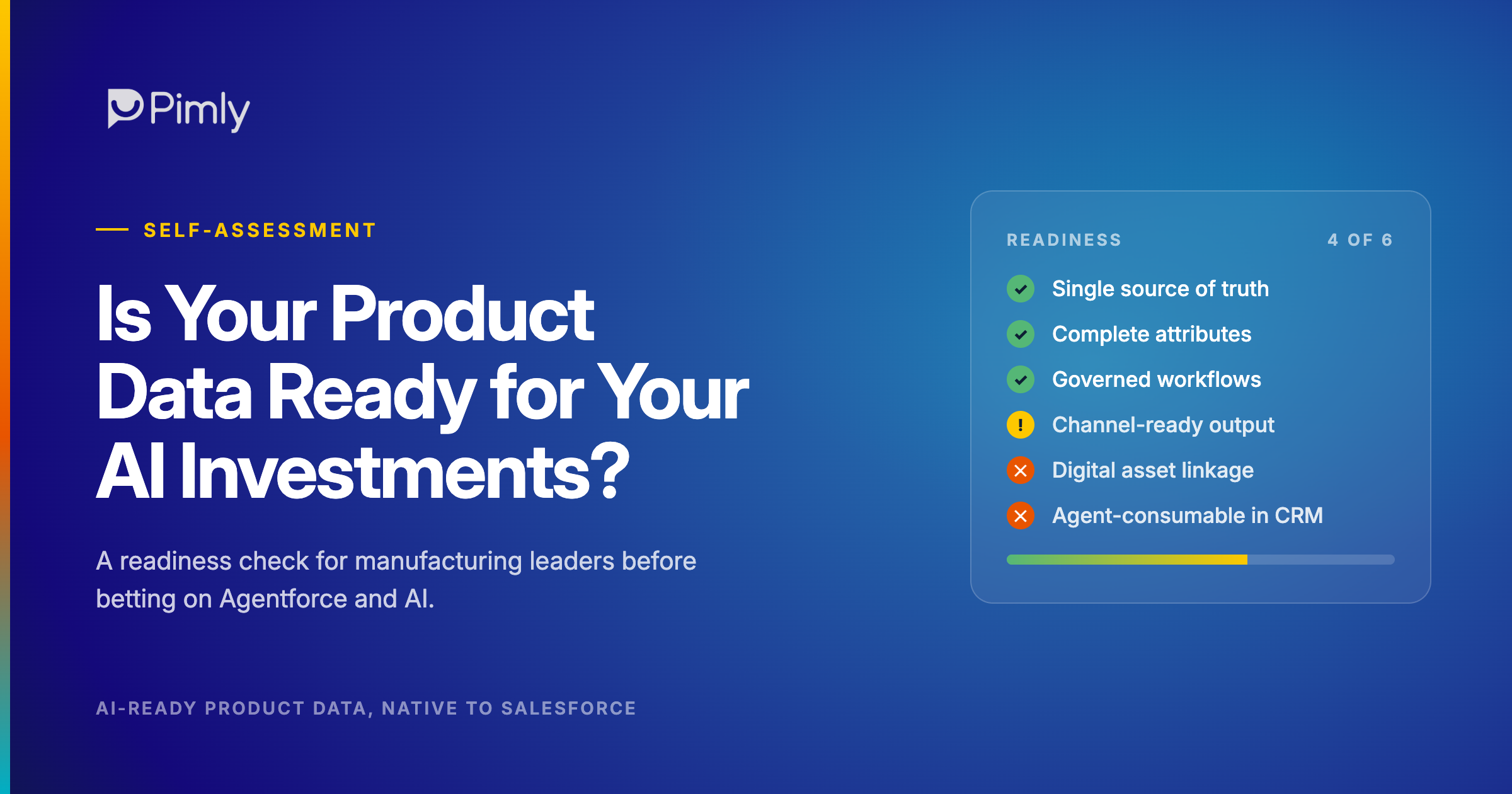
Is Your Product Data Ready for Your AI Investments?
.svg)
Before your team commits budget to Agentforce or any other AI initiative to support sales, revenue, service or eCommerce teams, there's a harder question to answer first: is your product data ready to support it?
Here's the failure mode in practice: a mid-market manufacturer with 500+ configurable SKUs launches an AI pilot, and within two weeks the agent quotes an incompatible part configuration to a customer. Sales ops finds the correct spec on a private spreadsheet nobody flagged as the source of truth; service finds a different version. The AI didn't fail — the data foundation underneath it did.
If you're a VP of Digital, CIO, or COO deciding whether now is the right time for an AI investment like this, this piece is a self-qualification framework: the signals that show your data isn't ready yet, what "ready" looks like, and what the first 90 days look like once you close the gap.
Key takeaways
- Every team touching product data — sales reps, service agents, ecommerce operators, marketers, and Agentforce agents — gets accurate answers grounded in the same governed record, instead of five different versions of the truth.
- AI-readiness has four dimensions: accurate, complete, structured, and governed. Missing any one of them, an AI agent will eventually surface a wrong or incomplete answer with full confidence.
- A mid-market manufacturer with 500+ configurable SKUs and an active Salesforce footprint is the clearest fit profile for this kind of self-assessment.
- Fixing the data foundation takes three steps — pull data in, organize it, distribute it — with real progress visible inside the first 90 days, not a phased, multi-quarter project.
Try the Free Product Data Grader to see where your own product data lands on the AI-readiness scale in about a minute.
What does AI-ready product data mean?
"AI-ready" gets used loosely, so it's worth being specific: AI-ready product data is accurate, complete, structured, and governed enough that an AI agent can use it without a person correcting the output afterward. Miss one dimension and the failure shows up differently — incomplete data produces a confident but partial answer, ungoverned data produces conflicting answers depending on which source the agent queries, and unstructured data (a spec buried in a PDF, not a field) can't be reliably parsed at all.
This isn't a claim that Pimly Product Intelligence gives every person the identical answer — it doesn't. It provides accurate answers grounded in your product data for every team member: a sales rep and a service agent asking related questions both pull from the same governed record, not literally the same sentence.
Shadow systems are the clearest early warning sign. When sales ops keeps a private spreadsheet of configuration rules, or service maintains a side document of "actual" compatibility notes, that's not a discipline problem — it's a diagnostic signal that the data foundation underneath Sales Cloud, Service Cloud, and Agentforce isn't governed enough to trust on its own.
Which signals show your product data isn't ready for AI?
Run through these before assuming your AI rollout has a clear runway:
Your catalog is fragmented across systems that don't agree. Product attributes living partly in Salesforce, partly in an ERP, and partly in a PLM system with no single record reconciling them means an AI agent querying any one source will eventually surface stale or contradictory information.
Nobody owns product data governance. With no defined process for who approves a new attribute, updates a spec, or retires a discontinued SKU, data quality degrades quietly until an AI agent makes the gap visible in front of a customer.
Product data lives outside Salesforce entirely. If reps, service agents, and AI tools work from Sales Cloud and Service Cloud but the authoritative record sits in a disconnected PIM or a shared drive, every AI answer is only as good as whatever got manually copied over last — see our breakdown of common product data challenges inside Salesforce.
Can your AI agent answer a real product question — compatibility, configuration, current spec — without a human correcting it? If the honest answer is no, that's the signal worth acting on before spending further on the AI layer itself.
Is Pimly the right fit for a manufacturer like yours?
The clearest fit profile: a mid-market or enterprise manufacturer managing 500+ configurable SKUs, already running an active Salesforce footprint — Agentforce Revenue Management (ARM), Agentforce Commerce, Sales Cloud, and Service Cloud, in that order of relevance — and feeling the early friction of an AI initiative stalling because the underlying data isn't governed yet.
If that describes your organization, the real self-qualification question is narrower than "do we need a PIM" in the abstract: can your product data support Agentforce and the other AI tools your teams already use, without an integration project standing between them and the record? Pimly runs natively on Salesforce, so there's no integration required and no subset of your catalog stranded outside the platform Agentforce already queries — a real risk with an external PIM, where only part of the catalog typically makes it across the integration, giving Agentforce incomplete context and unreliable outputs. For the specific readiness signals Agentforce checks for, see our 8-point Agentforce product data checklist for B2B manufacturers.
Cognex's IT director on centralizing product data before scaling AI
Diana Ferreira, Director of IT at Cognex, put it plainly after adopting Pimly's Product Intelligence: centralizing product data in one governed system meant faster customer resolution and more confident, AI-assisted selling — without a separate integration effort to maintain. That's the fit test worth applying to your own evaluation: not whether an AI tool impresses in a demo, but whether the data underneath it is governed enough to trust once real customers start asking real questions.
See what AI-ready product data looks like inside your own Salesforce org — book a demo.
What does the first 90 days look like after closing the gap?
Implementation anxiety is a real reason AI investments stall before they start — teams assume fixing the data foundation means a multi-quarter, phased rollout. It doesn't. Pimly's process is three steps: pull data in from ERP, PLM, spreadsheets, and every other source it's scattered across; organize it into a single governed record with real ownership and structure; then distribute it via SmartSync to ARM, Commerce, Sales Cloud, and Service Cloud as configurations inside Pimly — not standalone integration projects your IT team has to build and maintain.
Darley's 9-month payback
Darley evaluated the field before choosing Pimly and reached payback on that investment in 9 months — a useful benchmark for how fast a governed data foundation pays for itself, not a multi-year initiative. Inside the first 90 days, expect the fragmented-sources audit and initial governance rules done, the first wave of SKUs live and synced into Sales and Service Cloud, and your team able to run a real test: ask Agentforce a question that would have failed before, and watch it answer correctly.
The result: every rep becomes a product expert — answering confidently, quoting accurately, and winning more deals.
Passed the self-assessment and your teams already run on Salesforce? The next question is which PIM to pick — see our guide to choosing the best PIM for companies already on Salesforce.
Frequently asked questions
What is AI-ready product data?
AI-ready product data is accurate, complete, structured, and governed enough for an AI agent to use without a person correcting the output afterward. It's a higher bar than data simply existing somewhere — a spreadsheet can hold accurate numbers today and still fail the "structured and governed" test if nothing keeps it from drifting out of date. Data that clears all four dimensions is what lets Agentforce, or any AI tool, answer confidently instead of guessing.
What makes an organization ready for an AI initiative like Agentforce?
Readiness comes down to whether product data is unified in one governed system that Agentforce and other AI tools can query directly, rather than scattered across an ERP, a PLM system, and side spreadsheets that don't reconcile automatically. A mid-market manufacturer with 500+ configurable SKUs and an active Salesforce footprint is typically far enough along in Salesforce adoption that the gap is a data-governance gap, not a platform gap. Closing it is what turns an AI pilot into something reps and service agents can rely on.
How is an AI-readiness self-assessment different from a general PIM readiness checklist?
A general PIM checklist asks whether your catalog is complex enough to justify a product information system at all — catalog size, attribute count, number of sales channels. An AI-readiness self-assessment asks a narrower, higher-stakes question: can an AI agent answer a real product question today without a human correcting it. An organization can pass every general PIM criterion and still fail this test if governance and structure haven't caught up to what AI agents require.
Why isn't a manual data audit enough to prepare for AI investments?
A manual audit is a snapshot — it shows where your data stands the day you run it, but doesn't fix the underlying reason it drifted out of alignment, which is usually that multiple teams maintain their own version with no single governed record reconciling them. Without addressing that structural cause, the same gaps reappear within months, and an AI agent grounded on that data inherits the same inconsistencies. A durable fix requires a governed system of record, not a periodic cleanup exercise.
How does Pimly help mid-market manufacturers get AI-ready fast?
Pimly runs natively on Salesforce, so product data lives inside the same platform Agentforce, Sales Cloud, and Service Cloud already query — no integration project required and no risk of only a subset of the catalog making it across. The process is three steps: pull data in from every scattered source, organize it into one governed record, and distribute it via SmartSync as configurations to ARM, Commerce, Sales Cloud, and Service Cloud. Manufacturers evaluating Pimly typically see real progress inside the first 90 days, not a multi-quarter rollout.