What Do Salesforce's New B2B Commerce Agents Need From Your Product Data?
.svg)
Salesforce recently gave B2B buyers a Buyer Agent that negotiates, configures, and checks out largely on its own. The open question for anyone running Salesforce is what has to be true about the product catalog underneath it before that agent can be trusted with a real deal.
"B2B Commerce agents" means the specific agent set Salesforce has now shipped: a Buyer Agent that negotiates and closes on channels like WhatsApp, a Product Configurator that builds complex products on the storefront, Guided Shopping Agents that read a buyer's history and permissions, and AI-driven search that understands a plain-language request instead of requiring an exact SKU. Every one of these draws on the same underlying product catalog: taxonomy, compatibility rules, configuration logic, attributes, digital assets, channel and locale context, all kept current.
That's the real story in this release. B2B Commerce's new agentic experience is a genuine leap forward in what a governed, AI-ready catalog can do, but B2B Commerce doesn't make product data AI-ready on its own. A catalog that's fragmented and disconnected today stays that way once a Buyer Agent is pointed at it. Making the product catalog AI-ready first is the step that makes the Agentic Commerce experience pay off.
Get that foundation wrong, and the effect shows up immediately: a Buyer Agent that quotes the wrong configuration, a search result that misses a compatible part, or worse, a closed deal that ships the wrong part.
This article is for the VP of Digital, VP eCommerce, or IT Director deciding whether their catalog is ready for AI, including the Agentic Commerce experience Salesforce just shipped, and for the Salesforce AEs and SEs selling B2B Commerce into manufacturers and CG brands who still have messy product catalogs underneath.
Key takeaways
- Salesforce's 2026 B2B Commerce releases (the Spring '26 preview, the June GA, and the Winter '27 release landing October 12) all assume a governed, AI-ready product catalog sits underneath.
- An external PIM that integrates with Salesforce often carries only a subset of the catalog into Agentforce Commerce, which limits exactly the context these agents need to answer well.
- When the product catalog is complete enough to configure, quote, and check compatibility without human correction, then the buyers of Salesforce's Agentforce Commerce get a Buyer Agent that completes the sale, instead of one that mis-quotes or ships the wrong part.
- Pimly's SmartSync supports B2B Commerce as a configuration, alongside Agentforce Revenue Management (ARM) and Shopify, so manufacturers already running Pimly don't need a new integration project to use any of this.
- GE Vernova centralized roughly 200,000 SKUs in Pimly for the B2B Commerce platform that already runs about half its business, and saw a 5x lift in cross-sell as a direct result.
See where your own catalog stands before a Buyer Agent finds the gaps. Run it through Pimly's free Product Data Grader.
What Salesforce just shipped for B2B Commerce
Salesforce didn't ship B2B Commerce agents all at once. It built toward them across three releases in 2026, and the pattern is worth naming because it explains why product data keeps showing up as the constraint.
The Spring '26 preview introduced the self-service pieces: a Product Configurator that lets buyers assemble complex, configurable products directly on the storefront while checking manufacturability; Request for Quote flows that hand authenticated buyers from self-service into a sales-assisted quote without starting over; and Guided Shopping Agents that read a buyer's catalog access, negotiated pricing, and order history before recommending anything.
By June 2026, Agentforce Commerce reached general availability for B2B, and the agents got sharper. The Buyer Agent now negotiates and closes independently, on channels like WhatsApp and SMS, without a rep in the loop. Round-Trip Quoting turns an approved quote into a cart a buyer can check out from directly. AI-driven B2B Search stopped requiring an exact part number: a buyer can describe what they need in plain language and get a precise result. A new headless architecture, Headless360, lets manufacturers build the buying experience on modern frameworks while Salesforce still runs the backend.
The Winter '27 release, announced in September and generally available October 12, extends the same logic further. Agentic Commerce Search becomes standard for every Shopper Agent customer, with Salesforce citing early results of a 13% conversion lift and a 17% increase in add-to-cart rate, and Agentforce Revenue Management picks up self-service quoting for buyers, integrated quoting for partners, and automated renewal package assembly. Across all three releases, the direction is consistent: Salesforce keeps handing more of the buying decision directly to an agent, and less of it to a human who can catch a data problem first.
What these agents need underneath
None of the three Salesforce releases above ship a product data layer. They ship the interface: the chat window, the configurator UI, the search box, the quote-to-cart handoff. What answers the question is whatever catalog sits behind Agentforce Commerce, and that catalog has to clear a higher bar than the one B2B Commerce ran on before agents existed.
A Product Configurator can't check manufacturability without governed compatibility rules and attribute-level constraints, not just a flat list of SKUs. A Buyer Agent negotiating a deal on WhatsApp needs current pricing context, order history, and product relationships available in real time, not a nightly batch export. AI-driven B2B Search that understands "high load, saltwater" instead of an exact part number depends on attributes and specifications being populated, structured, and consistent across every SKU in the catalog. Round-Trip Quoting only works cleanly when the product record a rep quoted against and the record a buyer checks out against are the same record, not two versions that drifted apart because one lives in Salesforce and the other lives somewhere else.
This is the same argument Salesforce's own product catalog for Agentforce Revenue Management runs into on the quoting side: ARM's catalog is more capable than Salesforce's native Product2 object, but it still has a ceiling on digital asset management, taxonomy depth, and governance at scale for manufacturers running thousands of complex SKUs. B2B Commerce agents hit the identical ceiling from the storefront side. Whether the AI-readiness gap in Salesforce shows up in ARM, Agentforce Commerce, Sales Cloud, or Service Cloud, the underlying problem is the same: Product2 alone was never built to hold the hierarchy, variants, and digital assets a complex B2B catalog needs.
The subset problem: why "connected" isn't the same as "complete"
Plenty of manufacturers already run an external PIM connected to Salesforce, and it's tempting to assume that connection is enough to feed these new agents. It may be. But it usually isn't.
An integration between an external PIM and Salesforce depends on the quality of that specific integration, and depending on how it was built, it often carries only a subset of the full product catalog into Salesforce: the fields someone mapped when the integration was set up, not necessarily every attribute, every compatibility rule, or every digital asset the PIM holds. A Buyer Agent, a Product Configurator, or an AI-driven search index can only draw on what reached Salesforce. When the integration only carries part of the catalog, the agent has a limited set of data to work from, and the buyer gets an incomplete answer, even though the complete data exists somewhere in the connected system.
That gap doesn't announce itself. It shows up as a Buyer Agent that can't answer a compatibility question, or a configurator that lets a buyer build something the plant can't manufacture, and fixing it after the fact means re-scoping the integration, not just re-training the agent.
Book a Demo and see how Pimly gets a governed catalog in front of Agentforce Commerce, ARM, and Sales Cloud without a new integration project.
Pimly SmartSync: the product catalog publisher
Pimly makes our clients' product data live natively inside Salesforce, which means there's no separate integration to scope in the first place. SmartSync pushes the full governed catalog, taxonomy, bundles, attributes, digital assets, and translations, into ARM, Agentforce Commerce, Sales Cloud, and Service Cloud as configurations inside the platform a manufacturer already owns, not as a separate integration project with its own connector license and its own maintenance burden for each end-point.
That includes B2B Commerce. Pimly launched SmartSync this summer with Agentforce Revenue Management, B2B Commerce, and Shopify among its endpoints. Manufacturers already running Pimly and SmartSync have a governed, AI-ready catalog ready for the agentic commerce experience Salesforce just shipped.
Proof: GE Vernova built its B2B Commerce business on governed data
GE Vernova is the clearest example of what a B2B Commerce platform needs underneath it, because its Commerce story predates the agent releases above by years. GE Vernova invested in Salesforce B2B Commerce well before centralizing its product data, and that Commerce platform grew into the largest eCommerce operation in the wind industry, running roughly half the company's total business, while the product data behind it stayed fragmented across spreadsheets and manual updates, limiting how confidently the business could cross-sell.
GE Vernova then centralized close to 200,000 SKUs in Pimly, and cross-sell improved 5x as a direct result, a lift Salesforce featured in its AppExchange customer story. "GE Vernova has the largest eCommerce platform in the wind industry, and it is a strategic pillar of the business," said Bernardo Bandeira, Global Head of Digital Commerce at GE Vernova. "Leveraging Pimly to create a central source of truth for product data was essential to exceed the growth metrics we aimed to achieve." The Commerce platform came first, and the governed data that made it perform came after, which speaks to exactly what a Buyer Agent or a Product Configurator needs today: a catalog complete enough to trust.
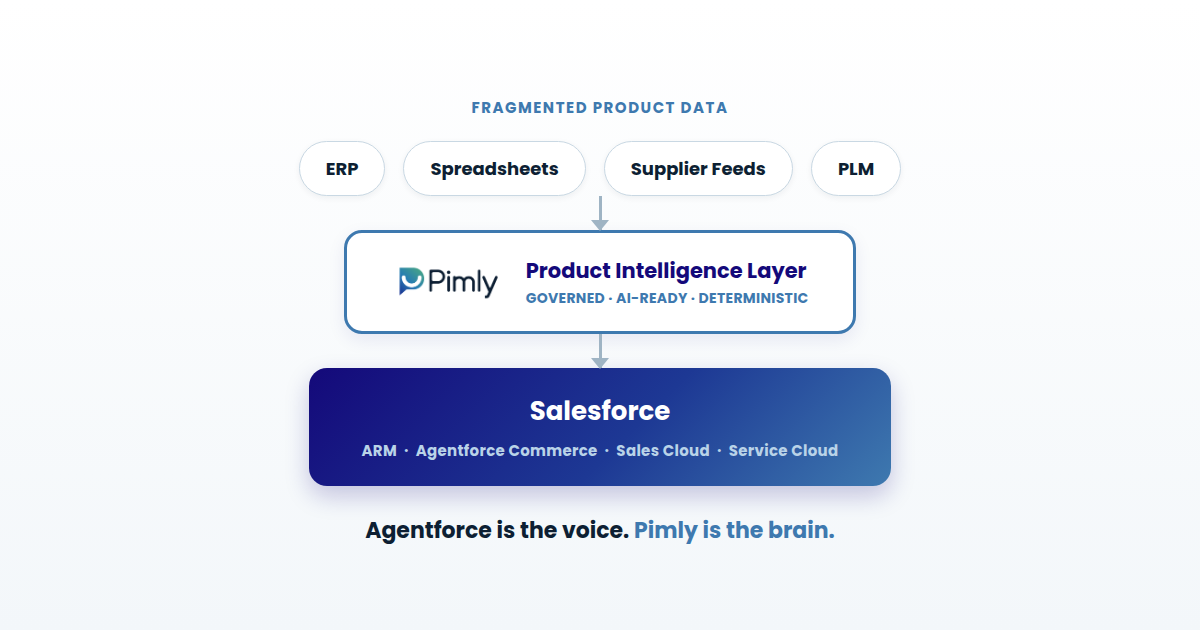
Agentforce is the voice. Pimly is the brain.
Agentforce Commerce is the interface a buyer talks to: the chat window, the configurator, the search box. It's the voice. Whether that voice gives an accurate answer depends on what's behind it, and that's Pimly Product Intelligence: a governed product model that Agentforce calls back into for every answer. Pimly Product Intelligence provides accurate answers grounded in your product data for every buyer interaction, whether that's the Buyer Agent negotiating on WhatsApp, the configurator checking manufacturability, or a rep stepping in on an exception. That grounding is what makes an agent trustworthy enough for a buyer to complete a purchase without a rep, which is the entire premise Salesforce built these releases around.
The result: every rep and AI agent becomes a product expert, answering confidently, quoting accurately, and winning more deals, and the buyer on the other end of a Buyer Agent conversation gets that same trustworthy answer without waiting on one.
None of this requires a bigger IT project to get started. If the product data challenges getting in the way today sound familiar (locked in spreadsheets, incomplete in Product2, or only partially integrated from an external system), the fix is the same one GE Vernova already proved out: centralize the catalog natively in Salesforce, in the order relative to whichever endpoint goes live first, and every agent Salesforce ships next, in B2B Commerce or anywhere else, inherits a foundation that's ready. That's true whether a B2B manufacturer is evaluating this for the first time or working from an ARM implementation already underway, and it's the same standard Agentforce needs from product data everywhere else in Salesforce, not just at the storefront.
Run your own SKU set through the Product Data Grader and see exactly what a Buyer Agent would find missing.
Frequently asked questions
What does Salesforce's Agentforce Commerce do for B2B buyers?
Agentforce Commerce gives B2B buyers a Buyer Agent that can negotiate, configure a complex product, request a quote, and check out largely on its own, on channels like WhatsApp or a company's own storefront. It reached general availability for B2B in June 2026, building on a Spring '26 preview of the underlying Product Configurator and RFQ flows. The agent's accuracy still depends entirely on the product data connected to it: it can only configure, quote, and answer questions correctly if the underlying catalog is complete and current.
Does an existing PIM connection to Salesforce automatically feed these new agents?
Not necessarily. An integration between an external PIM and Salesforce carries whatever fields and records that specific integration was built to carry, which is often a subset of the full catalog rather than everything the PIM holds. A Buyer Agent or search index can only draw on the data that reached Salesforce, so an incomplete integration produces incomplete answers even when the source PIM itself has good data. Confirming exactly what reached Salesforce, not just that something did, is the first step before trusting these agents with real buyers.
What's the difference between ARM and Agentforce Commerce when it comes to product data readiness?
Agentforce Revenue Management (ARM) handles quoting, pricing, and revenue processes, while Agentforce Commerce runs the storefront and buyer-facing agent experience, but both depend on the same underlying product catalog. ARM's native catalog is more capable than Salesforce's Product2 object, yet it still has real limits on digital asset management and taxonomy depth for complex manufacturers. Agentforce Commerce hits the identical ceiling from the buyer side, which is why a single governed catalog, not two separately maintained ones, is what closes the gap for both.
Does Pimly support B2B Commerce, or only Agentforce Revenue Management?
Pimly's SmartSync supports B2B Commerce as a configuration, alongside Agentforce Revenue Management and Shopify, all from the same managed job inside Salesforce. That means manufacturers already running Pimly can feed a governed catalog to B2B Commerce and the new Agentforce Commerce agents without a separate connector. Nothing about adding an endpoint requires a new integration project; it's a configuration inside the platform a team already owns.
How does Pimly keep a Buyer Agent's answers accurate across different channels and conversations?
Pimly Product Intelligence grounds every answer in one governed product record, so the facts behind it, compatibility, specifications, current pricing context, stay accurate and consistent no matter which channel or conversation the question comes through. The agent is reliable because it is drawing from the underlying product data records.
Does Salesforce's new B2B Commerce release make my product data AI-ready by itself?
No, and this is the point most conversations about the release skip past. B2B Commerce's new agentic experience is a genuine leap forward in what a governed, AI-ready catalog can do, activating it for buyers in ways that weren't possible before, but the release itself doesn't fix fragmented or disconnected product data. A catalog scattered across spreadsheets, ERPs, and partial Salesforce records is exactly as fragmented after the agents show up as it was before. Making that product catalog AI-ready first, accurate, complete, structured, and well-governed enough for a Buyer Agent to draw from, is the step that determines whether Salesforce's new B2B Commerce agents deliver for a given business.