Should You Fix Your Product Data Before or After CPQ and Commerce Go Live?
.svg)
If your company already has CPQ or Agentforce Revenue Management (Revenue Cloud) or Agentforce Commerce live in Salesforce, and your product data is still a mess of spreadsheets and manual updates, is it too late to fix it in the "right" order? That's the question most VPs of Sales Ops, IT Directors, and product data managers face after they spend months getting their CPQ and Commerce platforms live, only to find out they're not seeing the ROI they anticipated.
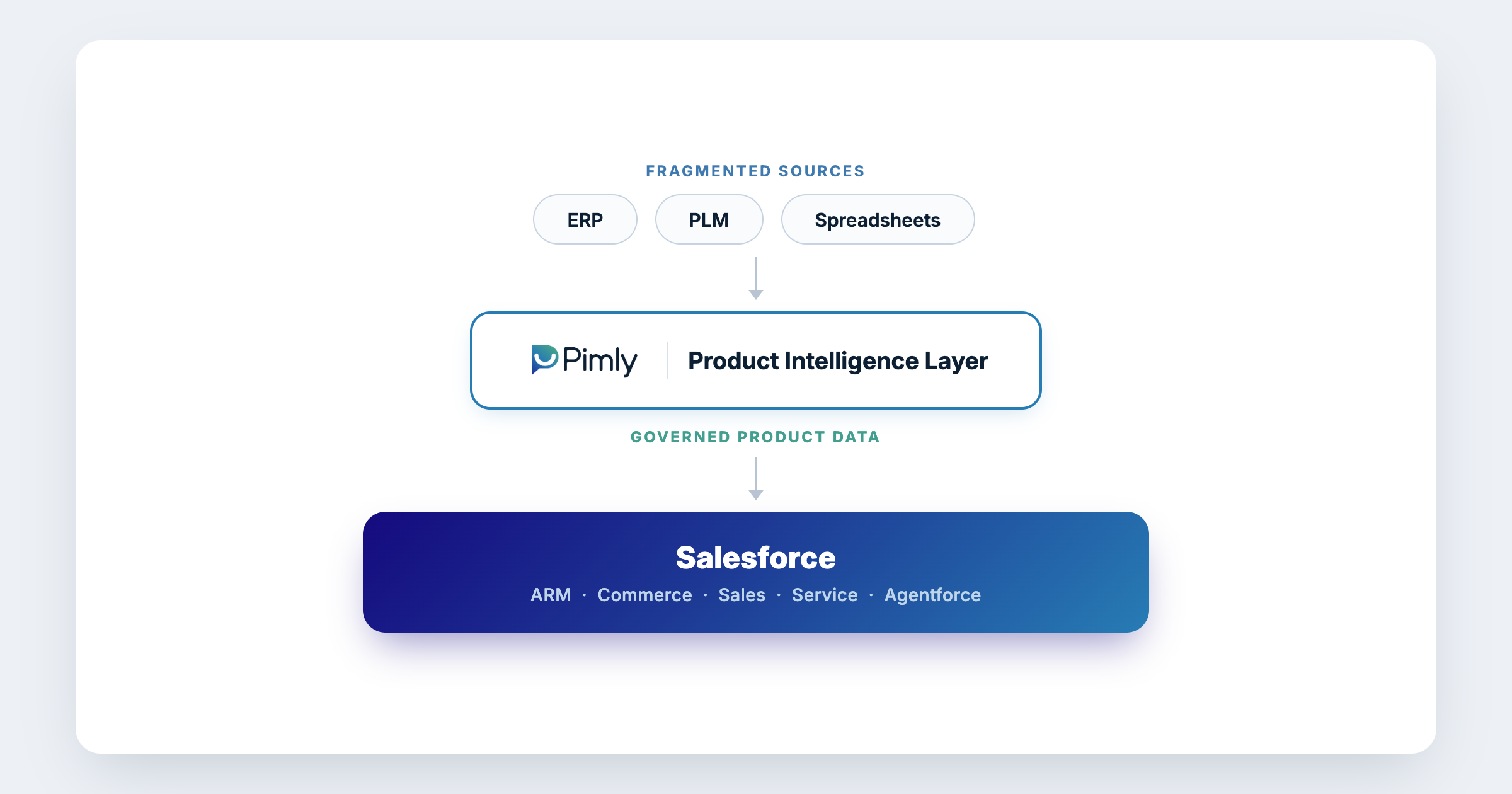
The textbook order puts product data first: pull every SKU, attribute, and spec into one governed model, make it accurate, complete, and structured, and then connect it to Agentforce Revenue Management (ARM), Agentforce Commerce, Agentforce itself, Sales Cloud, and Service Cloud. Every endpoint is only as good as the data feeding it, so building the foundation first means nothing downstream ever runs on bad data.
In practice, almost no one builds it that way. Most manufacturers and consumer goods brands already have Sales or Service Cloud running, and they agree to a CPQ/ARM or Commerce expansion project before anyone stops to ask whether the product data underneath is ready. The gap shows up as wrong quotes, reps improvising with private spec sheets, and a Commerce site nobody fully trusts to expand. Those aren't platform limitations; they're just not being built on a foundation of clean, structured product data needed to be highly successful.
This is for the sales ops leader, IT director, or product data manager who is contemplating the order of implementation, or already has one or more of these systems live and is wondering why it didn't meet their expectations.
Key takeaways
- Sales reps and service agents get accurate quotes and answers the moment the product data underneath ARM, Commerce, Sales Cloud, and Service Cloud is fixed — whether that happens before or after those systems go live.
- The technically ideal order is product data first, then every Salesforce endpoint. That's a textbook sequencing preference, but it rarely matches reality. Few real customers build in the ideal order. Most already have one or more endpoints running before they invest in the product data foundation underneath it.
- GE Vernova is a live example: they built their B2B Commerce platform two years before centralizing their product data in Pimly, then saw cross-sell improve 5x once they closed the product data gap.
- Building out of the textbook order isn't a failure. It's a delay. Every quarter the data foundation waits is a quarter the endpoint you already paid for isn't delivering its full value.
See how ready your product data actually is before you connect the next Salesforce endpoint — try the free Product Data Grader.
What is the ideal order for product data, ARM, Commerce, and Agentforce?
Getting product data ready isn't a mysterious, drawn-out overhaul. It comes down to three steps: pull data in from wherever it currently lives — ERPs, PLMs, spreadsheets, supplier feeds; organize it into one governed, structured model with accurate, complete attributes; then distribute it to every system that needs it.
That third step is where the "order of operations" argument actually lives. Once product data is governed in one place, then it can go to the endpoints your organization decides are the highest priority. AI tools like Agentforce, Claude and others can layer on top of every endpoint, drawing on the same governed data to answer questions reliably and take the appropriate actions.
Doing it in that order means nothing downstream — no quote, no product page, no case resolution — is ever built on a record that hasn't been checked. That's the textbook case for PIM best practices: fix the source before you connect the pipes.
Why almost nobody builds it in that order
Salesforce endpoints get purchased to solve an immediate, visible need. A CFO wants a self-service ordering channel, so Commerce gets funded. A VP of Sales wants faster, more accurate quotes, so ARM gets funded. Nobody schedules "fix the product data" as its own initiative first, because until a quote comes back wrong or a customer can't find a compatible part, the data problem is invisible.
By the time it does become visible, the endpoint is usually already live. Reps are maintaining private spec sheets because the catalog in Salesforce doesn't match what's actually shipping. Product managers are emailing corrections instead of updating a system of record. Those aren't discipline problems — they're a signal that the product data quality underneath a system everyone already paid for was never actually fixed, a pattern especially common among manufacturers managing thousands of SKUs across multiple product lines.
What happens when a real customer builds it out of order
GE Vernova: Commerce first, product data second, 5x cross-sell after closing the gap
Two years before addressing their product data challenges, GE Vernova invested in Agentforce Commerce (Commerce Cloud, at that time), building what became the largest eCommerce platform in the wind industry and roughly half of the company's total business. That investment came first. The product data underneath it did not.
GEV's product information relied on disconnected spreadsheets and manual daily updates. That fragmentation created four concrete problems: inaccurate product data from the constant manual-update cycle, poor governance across a vast catalog with no centralized system, field reps who couldn't identify replacement parts without viewable product images and technical diagrams, and missed cross-sell and up-sell opportunities because reps had no real-time view of new parts and compatible upgrades. GE Vernova was still reaching for the growth metrics it expected from its B2B Commerce investment.
Then they tackled the product data. Pimly became the backbone underneath the Commerce platform GEV had already built, centralizing and governing a catalog of roughly 200,000 SKUs. Cross-sell improved 5x following that implementation, and AI agents now answer complex technical queries against the same governed catalog.
As Bernardo Bandeira, Global Head of Digital Commerce at GE Vernova, put it: "GE Vernova has the largest eCommerce platform in the wind industry, and it is a strategic pillar of the business. Leveraging Pimly to create a central source of truth for product data to power the B2B Commerce experience was essential to exceed the growth metrics we aimed to achieve." (Read the full GE Vernova story.)
GE Vernova didn't build in the textbook order. They built the endpoint first and the foundation under it second. It worked — the 5x cross-sell lift is proof of that — it just means the growth they're seeing now had to wait until they fixed the product data foundation.
Curious what closing that same gap looks like inside your own Salesforce org? Book a demo and see how SmartSync connects an existing ARM or Commerce deployment to one governed source of truth.
Does the order actually change the outcome, or just the timeline?
The order changes how fast you see value, not whether you get there. If ARM or Commerce is already live, fixing the product data underneath it doesn't mean ripping anything out. Pimly SmartSync distributes a governed catalog to each Salesforce endpoint as a configuration inside the platform you already own — not a separate integration project — so connecting an endpoint you already bought works the same way as if you'd connected it on day one.
The real cost of the reversed order is time. Every quarter spent quoting from an ungoverned catalog, or running a Commerce site nobody fully trusts, is a quarter of value the endpoint isn't delivering — the kind of gap a PIM ROI analysis is built to quantify. That cost compounds, but it isn't permanent — payback still comes fast once the foundation is in place. W.S. Darley & Co reached payback on its Pimly investment in nine months, evidence that fixing the data late doesn't mean waiting years to see the return.
What "getting product data ready" actually requires
Whichever order you're doing it in, readiness comes down to this: accurate, complete, and structured data, governed in one place. A lot of what's missing isn't even in a field yet — it's trapped in PDFs, spec sheets, and technical drawings that nobody has connected to the record. Pimly's Asset Intelligence solves that specific gap, scanning unstructured sources and making their content searchable as part of the same governed record instead of leaving it buried.
Once that foundation exists, SmartSync is what actually gets it in front of the people and systems that need it — pushing the governed catalog to Agentforce Revenue Management, Agentforce Commerce, Sales Cloud, and Service Cloud as configurations, not new integration work every time something changes. We even use the same SmartSync technology to ship your governed, structured product catalog to Shopify, for the organizations running a storefront outside Agentforce Commerce.
None of this requires a CRM to double as a product data source — ERPs, PLMs, spreadsheets, and supplier feeds are legitimate sources; a CRM isn't. And it doesn't require addressing every product data challenge in Salesforce at once. It requires one governed source, connected to whatever endpoints are already live.
What to read next if you're already mid-implementation
This article is about when and why to invest in fixing product data relative to the Salesforce endpoints you already have — not about what breaks day to day when reps and service agents work from bad data. We've covered those consequences directly elsewhere, in Why Salesforce Sales Enablement Fails on Bad Product Data.
If you're specifically trying to get an in-flight ARM deployment unstuck right now, the tactical, step-by-step version of this same problem is How Do You Get Your Product Catalog ARM-Ready Before Implementation Stalls? — that piece is about ARM specifically. This one sits a level above it: the sequencing philosophy across every endpoint — ARM, Commerce, Sales Cloud, Service Cloud, and Agentforce — not just the one you're mid-deployment on.
The big picture: one product data foundation, whichever order you got there
Whether product data comes first or gets retrofitted underneath a system you already bought, the end state is the same: one governed, AI-ready product data foundation in Pimly, distributed through SmartSync to every Salesforce endpoint, with Pimly Product Intelligence and your AI tool drawing on it to answer questions reliably and take appropriate actions.
Sequencing isn't even always all-or-nothing. Cognex bought Pimly's PIM first, ran on it as their governed foundation, and only later layered on Agentforce and Pimly Product Intelligence as an early adopter — a different kind of staged order that still ends in the same place. Whether you're GE Vernova retrofitting a live Commerce platform, Cognex staging PIM and AI adoption a step apart, or a team building product data first the way the textbook describes, the destination doesn't change.
The result: every rep becomes a product expert — answering confidently, quoting accurately, and winning more deals — regardless of which order got them there.
Ready to find out what's actually slowing your ARM or Commerce results down? Try the free Product Data Grader and get a complimentary report on your product data's AI-readiness.
Frequently asked questions
What is the ideal order for connecting product data to ARM, Commerce, and Agentforce?
The ideal order is product data first: pull every SKU and attribute into one governed, structured model, then connect it to Agentforce Revenue Management, Agentforce Commerce, Sales Cloud, and Service Cloud, with AI (Agentforce, Claude, or others) drawing on the same data across all of them. Building the foundation first means every quote, product page, and case resolution runs on checked data from day one. It's the technically cleanest path, but it's a preference for teams starting from scratch, not a requirement for teams that already have an endpoint live.
Do I need to fix my product data before I turn on ARM or Commerce?
No. If ARM or Commerce is already live, you don't need to pause it or unwind it to fix the product data underneath it. SmartSync connects a governed catalog to an existing endpoint as a configuration, the same way it would if the endpoint hadn't launched yet, so the fix happens in parallel with what's already running rather than blocking it.
What happens if ARM or Commerce is already live before my product data is ready?
Nothing breaks that can't be fixed — but the endpoint underperforms until the data underneath it is governed. Reps quote from incomplete catalogs, Commerce buyers see gaps or inconsistencies, and cross-sell opportunities get missed because nobody has a real-time view of what's compatible with what. GE Vernova ran this way for two years before centralizing their product data in Pimly, then saw cross-sell improve 5x once the foundation caught up to the endpoint.
Why isn't waiting for a "clean slate" the right approach?
Waiting for a clean slate treats the ideal order as a requirement instead of a preference, and it leaves real revenue on the table while you wait. An endpoint that's already live and underperforming because of bad data is losing value every quarter it stays unfixed. Closing that gap now, on top of what's already built, captures value faster than ripping everything out and starting over on a theoretically cleaner timeline.
How is this different from getting my catalog ARM-ready?
Getting a catalog "ARM-ready" is the tactical checklist for one specific endpoint — the technical requirements Agentforce Revenue Management needs from your product data to quote correctly. This article is the broader sequencing philosophy behind that checklist, covering ARM, Commerce, Sales Cloud, and Service Cloud together. Start here if you're deciding when and why to invest in your product data foundation at all, then move to the ARM-specific piece once you know that's the endpoint you're prioritizing first.