How Is Cognex Preparing AI-Assisted Quoting for 1,500 CRM Users?
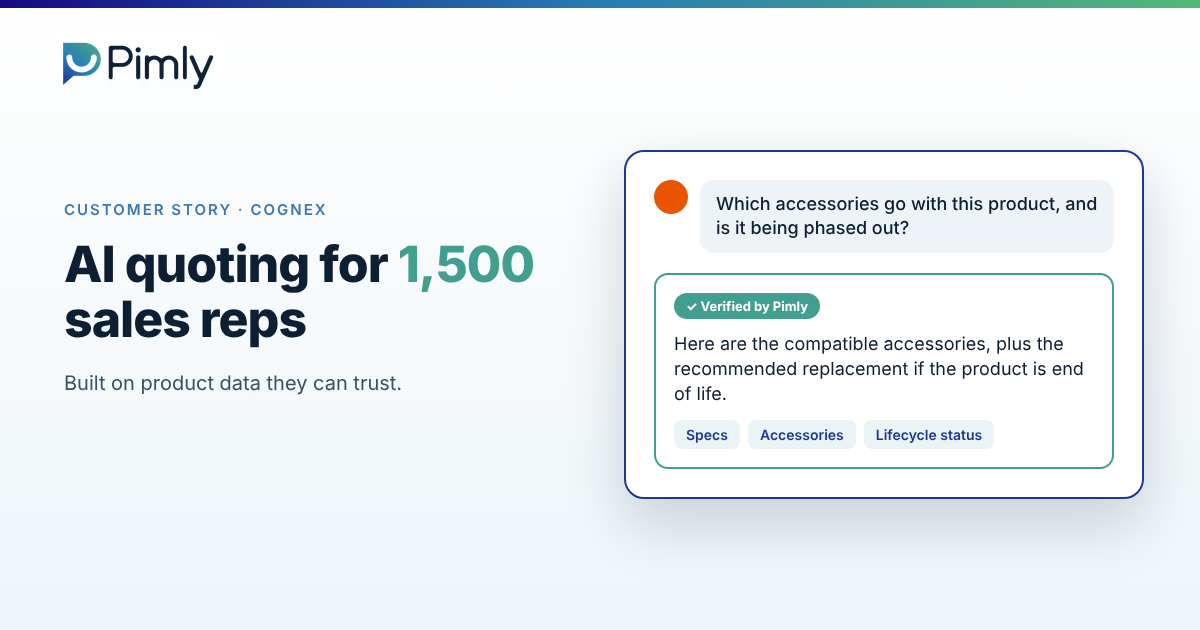

What does it take for AI to automate quoting for 1,500 sales reps? At Cognex, a machine vision manufacturer, the answer starts with the product data underneath the AI, and with where that data lives.
Cognex is preparing to take Pimly Product Intelligence live across 1,500 sales reps, and the rollout is in testing. Product Intelligence is the layer that gives sales reps, service agents and AI agents accurate answers grounded in governed product data, so product questions get answered from one source. The use cases Cognex is testing include spec search during quoting, accessory prompts and end of life swaps.
AI quoting only works when the answers are right, and Cognex did the groundwork first. Before Pimly, a release meant a product that sales could quote and little else. "We weren't launching products with rich product data," says Trevor Bernier, Senior Manager, Product Management at Cognex. "We were launching products and then reacting to requests for data."
This story covers what Cognex is building, and what it has already achieved by moving front office product data out of SAP and into Pimly, a Salesforce-native PIM. It is written for sales operations and IT leaders at manufacturers who struggle with fast and accurate quoting or other challenges related to product data residing outside of Salesforce where their front-office sales and service teams live.
Key takeaways
- Cognex is preparing to put AI quoting support in front of 1,500 sales reps with Pimly Product Intelligence.
- Reps already reach every spec, image and accessory in one click from the quote.
- Product management maintains front office product data directly.
- On a recent release, inheritance alone cut product data work by about 60%, according to Trevor Bernier.
- Products now launch with rich product data from day one instead of collecting it later, on request.
Want to see how Cognex built the foundation for AI quoting? Read the full Cognex white paper.
What is Cognex building with Product Intelligence?
Cognex is exploring how AI fits its sales and support workflows. The team is testing spec search during quoting, accessory prompts and end of life swaps, with Product Intelligence set to reach 1,500 sales reps. These use cases are still in testing, and we will update this story when the rollout goes live.
Trevor's view of the foundation matches Pimly's. "It's kind of like Claude or ChatGPT," he says. "They're only as great as the data that's available to them." Our guides on AI ready product data and why Agentforce fails without product data readiness make the same case in more detail.
Why did Cognex fix product data before adding AI?
Front office attributes lived in SAP material master, the same record that drives costing and manufacturing. That made it a controlled record. Only a small group could edit it, and every change meant a ticket and a wait.
Product data also lived in six places at once: documentation, the quoting system, CRM, the website, offline Excel files and Power BI. "All of those places could say different things," Trevor says. "There's no centralized source of truth."
Sales felt it most. The product page reps saw pulled its attributes from SAP, with no images and a long list of fields, most of them empty. "It was lost in the sea of white," Trevor says. If your ERP knows every SKU while your reps and service agents do not, our look at ERP versus PIM for Salesforce teams explains why the gap exists.
What changed when product management took over the data?
Cognex met Pimly at an event in Boston, saw a demo and saw a clear fit. Trevor built the business case around sales speed and tied it to Cognex's own motto: work hard, play hard, move fast. "I really pitched it as a way to keep our sales teams moving fast, to stop that barrier that grinds everything to a halt," he says.
Front office product data then moved out of SAP and into Pimly, where the people who know the products maintain it. Diana Ferreira, IT Director of Business Applications at Cognex, describes the split: her IT team owns the platform and Trevor's product managers own the data. "The maintenance is now on the product management team," she says. In 2026, Cognex rebuilt its Salesforce product pages entirely on Pimly, alongside Agentforce Sales and Agentforce Service.
Because Pimly runs natively in Salesforce, the product record lives in the org where reps build quotes and support works cases. "To them it feels like it's still within Salesforce, 'cause the way that we enter Pimly is through Salesforce," Diana says. Reps reach the full product page in one click from a quote. Those pages now carry images, the specs that apply, accessories, assets and named replacements, which is the view sales teams need at the moment of the quote.
How Cognex designed its product hierarchies and data models with Aleysian, Pimly's implementation partner, and how Trevor structured the business case, is covered in the full white paper.
Get the full Cognex story, including how the product data foundation was designed. Download the white paper.
What did Cognex gain from one governed product record?
Trevor calculated the headline number himself. "For one of our recent releases, it reduced the workload by about 60%," he says. "So only that, just the inheritance model itself." Inheritance means shared product data is entered once and passed down the product hierarchy. The field counts and the setup behind that figure belong to the white paper.
The time saved now goes to positioning and to how the team communicates a product to sales. Updates move faster too. "The lead time is where we won," Diana says. Products launch with rich product data from day one. "We really changed the quality of those releases, from the start," Trevor says.
Sales sees the difference. "It just helps our sales team visualize what they're quoting and selling," Trevor says. Diana adds: "We just keep adding more and more functionality to it, and sales loves it, not only product management." Trevor sums up the response: "Feedback has been overwhelmingly positive. It's incredibly valuable for sales and support to have everything in one place."
What can other manufacturers take from the Cognex story?
The setup is common. Product data lives in the ERP, but reps sell in Salesforce. Quotes go out without the full picture of images, specs and accessories, and every product data change waits on a ticket. Cognex changed who owns the data and where it lives, and that foundation is what its AI quoting work builds on. Manufacturers on Salesforce can follow the same sequence: fix the product record first, then put AI on top.
If you are weighing that first step, start with how to choose a PIM when you already run Salesforce, why Agentforce needs governed product data, and where PIM is heading next.
That is the outcome Pimly is built for. The result: every rep becomes a product expert, answering confidently, quoting accurately, and winning more deals.
See what your sales team could know about your catalog. Book a scoped demo built around your SKU complexity.
Frequently asked questions
What is Cognex doing with AI quoting?
Cognex is preparing to take Pimly Product Intelligence live across 1,500 sales reps. The team is testing spec search during quoting, accessory prompts and end of life swaps. These use cases are still in testing and have not gone live.
Why does AI quoting depend on product data?
AI quoting can only answer from the data it can reach. Trevor Bernier of Cognex puts it this way: AI tools are only as great as the data that's available to them. That is why Cognex moved its front office product data into one governed record before adding AI.
Why does product data get stuck in an ERP like SAP?
At Cognex, front office attributes lived in SAP material master, the record that also drives costing and manufacturing. Because that record is controlled, only a small group could edit it. Every change meant a ticket and a wait, and products launched before their data was ready.
What is product data inheritance?
Inheritance lets a team enter shared product data once and pass it down the product hierarchy instead of entering it on every SKU. On one recent release at Cognex, inheritance alone cut the data work by about 60%, according to Trevor Bernier. The full white paper covers how Cognex set it up.
Who should own product data, IT or product management?
At Cognex, the IT team owns the platform and the product managers own the data. Product managers own each product line from market requirements to end of life, and the maintenance is now on their team. That split gives front office product data a clear owner.