Why Does Agentforce Need Governed Product Data to Work?
.svg)
Your Salesforce Admin deployed Agentforce. Your CIO signed off on the investment. So why is Agentforce still giving sales reps and service agents wrong answers about your products?
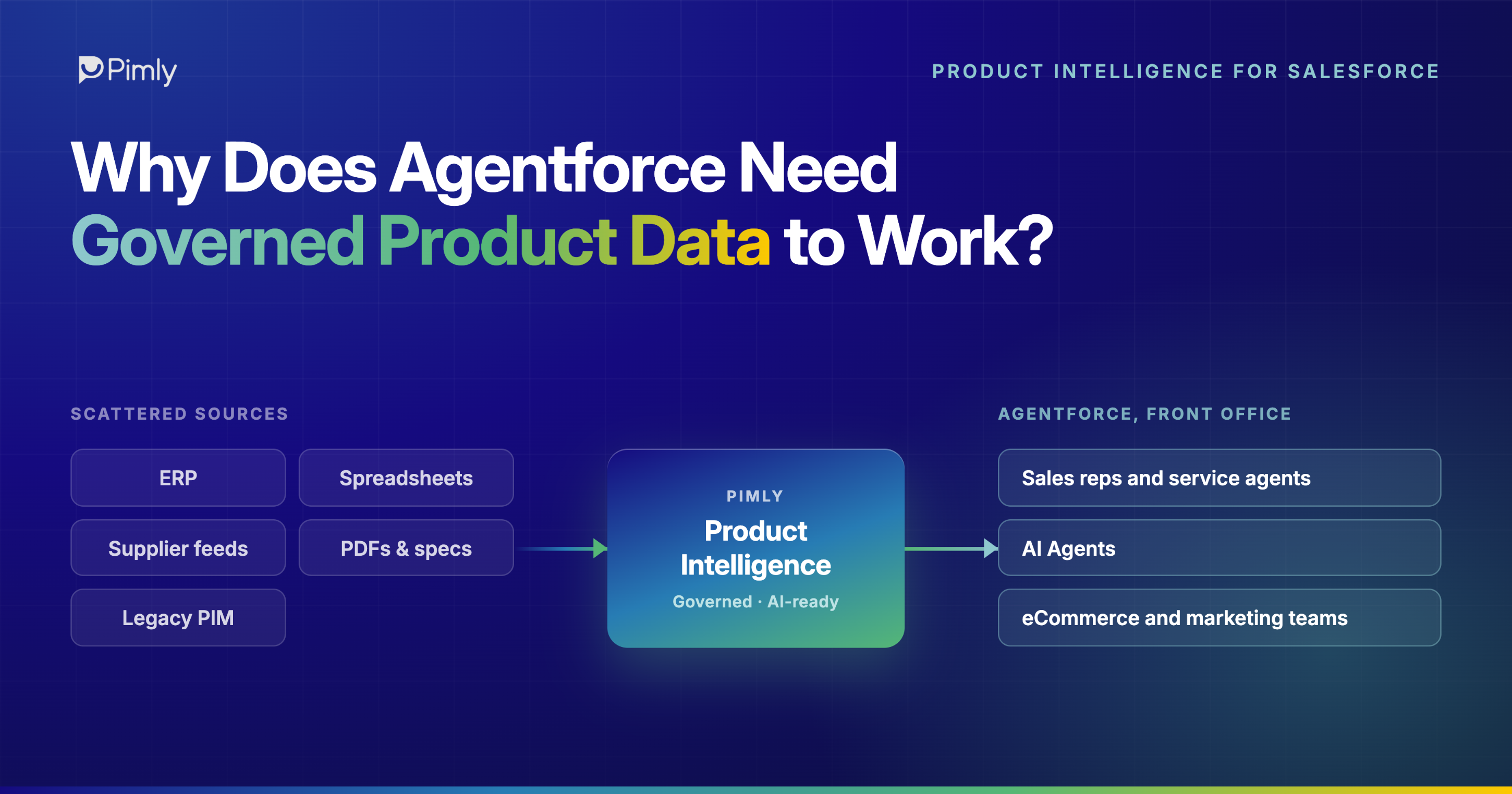
Agentforce needs governed product data because it has no independent way to know what your company actually sells. Governed product data means every SKU, configuration, and spec lives in one accurate, structured record that's actively maintained — not scattered across ERPs, spreadsheets, and private files. Without that foundation, Agentforce can only guess at answers using whatever fragments of product data it can find inside Salesforce, and a guess is not the same as an answer a rep can quote to a customer.
Picture a service agent handling a live case: a customer asks whether a discontinued part is compatible with a newer model. If that compatibility data lives in a spreadsheet on a product manager's desktop, Agentforce has nothing to draw from. The least worst outcome is that it just doesn't work and hands the case back to a human; the worst outcome is that the agent confidently provides the wrong answer back to the customer who then orders the wrong, incompatible part.
This is the gap VPs of Digital, CIOs, and COOs run into as they scale Agentforce past its first use case: the agent is only as capable as the product data underneath it. This article is for Salesforce Admins and IT leaders deciding how to close that gap before it stalls the broader Agentforce rollout.
Key takeaways
- Agentforce can only answer questions as well as the product data it can reach — fragmented data produces fragmented answers, not full agent failure.
- With a governed product catalog for Agentforce to reference, Sales reps and service agents get accurate, on-the-spot answers to product questions instead of escalating to engineering or guessing.
- Pimly Product Intelligence, available on Salesforce AgentExchange since its March 2026 launch, gives Agentforce a governed source of product truth natively inside Salesforce — no integration required.
- Cognex Corporation became the first customer to put Pimly Product Intelligence into production with Agentforce, centralizing product data across Sales and Service without leaving Salesforce.
- Closing the product data gap before scaling Agentforce protects the adoption and ROI of the broader Salesforce investment, not just the AI initiative.
See what governed product data looks like feeding your own Agentforce deployment — book a demo.
Why is Agentforce giving inaccurate answers about your products?
Agentforce doesn't fail on its own — it fails on the data underneath it. When product data lives outside Salesforce, in ERPs, PLM systems, or a product manager's spreadsheet, Agentforce has no governed source to draw from and produces answers that are incomplete, outdated, or simply wrong.
Even product data that already lives in Salesforce isn't automatically enough. Product2 records in Sales and Service Cloud typically capture the basics — name, SKU, price. Agentforce Revenue Management (ARM) has a more capable product catalog built for quoting and configuration, but ARM's catalog still has a ceiling for complex manufacturers — it wasn't built to hold full technical specs, compatibility rules, or digital assets. Neither one, on its own, gives Agentforce what it needs to answer a detailed product question with confidence.
Shadow systems are the tell. When service agents keep a private spreadsheet of compatibility exceptions, or sales reps text engineering to confirm a configuration, that's not a training gap — it's a signal that the product data foundation Agentforce depends on isn't there yet.
How do you prepare your product data for Salesforce Agentforce?
Preparing your product data for Agentforce starts with centralizing it, not cleaning it in place across five different systems. Pimly pulls product data from ERPs, PLM systems, spreadsheets, and shared drives into one governed record inside Salesforce — no integration required. From there, SmartSync pushes that governed catalog out as configurations inside Pimly, not separate integration projects, to every endpoint your revenue teams and Agentforce already touch: Agentforce Revenue Management (ARM), Agentforce Commerce, Sales Cloud, Service Cloud, and Agentforce itself.
Pimly Product Intelligence, available on Salesforce AgentExchange since its March 2026 launch, is the layer that makes that governed catalog usable by AI. It structures product data at the record level — attributes, compatibility rules, digital assets — so Agentforce has a single, trustworthy source to query instead of piecing together partial answers. For the fuller architecture story on how Agentforce and Pimly Product Intelligence work together, see Why Salesforce Agentforce Needs Pimly's Product Intelligence.
Try our Free Product Data Grader to see how AI-ready your own product data is today.
How does governed product data power Agentforce across the front office?
Once product data is governed and accessible, Agentforce stops guessing and starts acting. Sales reps get accurate answers to complex configuration questions without leaving Salesforce, so they quote correctly on the first pass instead of following up after checking with engineering. Service agents resolve cases directly — pulling the right compatibility answer, warranty detail, or replacement part instantly, instead of escalating or asking the customer to wait. Ecommerce operators and marketers work from the same governed catalog when publishing product content, so what a customer sees on the storefront matches what a rep quotes on a call. Agentforce bots deflect the straightforward cases entirely, resolving warranty and product-matching questions without a human touch.
The result isn't that every team gets the identical answer word for word — it's that every team gets an accurate answer grounded in the same governed product data, whether they're closing a deal, resolving a case, or publishing a product page.
How Cognex put Agentforce and Product Intelligence into production
The clearest example of this working at scale is Cognex Corporation.
Cognex Corporation's Product Intelligence rollout
Cognex, an existing Salesforce customer, implemented Pimly's Salesforce-native Product Data Layer (PIM) in December 2024 to centralize product data that had been scattered across disconnected systems, slowing down Sales and Service teams who relied on Salesforce every day. By February 2026, Cognex became the first customer to put Pimly Product Intelligence into production, activating that governed catalog through Agentforce for product discovery, recommendations, and customer service responses.
"Implementing Pimly's Salesforce-native PIM fundamentally changed how we manage product information across Cognex," said Diana Ferreira, Director of IT at Cognex. "We moved from fragmented data sources to a centralized, governed foundation inside Salesforce."
Cognex didn't need a separate integration project to get there, and its Sales and Service teams didn't have to leave Salesforce to use it — the governed catalog was already where Agentforce could reach it.
After AI cleans and structures my product data, how do I use it to power Salesforce Agentforce?
Once your product data is centralized, governed, and structured in Salesforce, using it to power Agentforce isn't a separate project — it's the same foundation working across every endpoint your front office already touches. ARM quotes correctly because it's pulling from accurate, current configuration data, not a stale export. Service Cloud resolves cases because the compatibility answer already lives where the agent is looking. Commerce and Sales pull from the same record, so what's published and what's quoted always match.
The result: every rep becomes a product expert — answering confidently, quoting accurately, and winning more deals.
Would you like to see how ready your product data is to power your own Agentforce deployment? Try the free grader.
Frequently asked questions
What is Pimly Product Intelligence?
Pimly Product Intelligence is the AI capability layer built on top of Pimly's Salesforce-native Product Data Layer (PIM), launched on Salesforce AgentExchange in March 2026. It structures governed product data — attributes, compatibility rules, digital assets — so Agentforce can answer product questions accurately instead of guessing from incomplete records. Cognex Corporation was the first customer to put it into production, activating centralized product data through Agentforce for its Sales and Service teams.
What makes product data ready for Agentforce?
Product data is ready for Agentforce when it's accurate, complete, structured, and well-governed enough for AI to use without human intervention. That means every SKU's attributes, compatibility rules, and specs live in one record instead of scattered across ERPs, spreadsheets, and private files. When that foundation exists, Agentforce answers a detailed product question correctly the first time instead of escalating it to a human.
How is Pimly Product Intelligence different from Agentforce alone?
Agentforce is the interface — it understands intent, orchestrates workflows, and holds the conversation with the rep or customer. Pimly Product Intelligence is the governed product knowledge layer Agentforce draws from to answer product-specific questions accurately. Without it, Agentforce works from whatever fragments of product data happen to sit in Product2 or the ARM catalog; with it, Agentforce has a single, structured source of product truth to query.
Why isn't Salesforce's native product data enough for Agentforce?
Product2 records in Sales and Service Cloud typically hold the basics — name, SKU, price — but not the full technical specs, compatibility rules, or digital assets a detailed product question requires. Agentforce Revenue Management (ARM) has a more capable product catalog built for quoting and configuration, but it still has a ceiling for complex manufacturers managing thousands of SKUs and variants. Neither was built to be the complete, governed source of product truth Agentforce needs — that's the gap Pimly's Product Data Layer closes.
How does a PIM help prepare data for Agentforce?
A Salesforce-native PIM centralizes product data from ERPs, PLM systems, and spreadsheets into one governed record inside Salesforce, so no integration is required to connect it to Agentforce. Pimly's SmartSync then makes that catalog available as configurations inside Pimly to Agentforce Revenue Management, Agentforce Commerce, Sales Cloud, Service Cloud, and Agentforce itself. That's what turns fragmented product data into the accurate, structured foundation Agentforce needs to work.