Claudeforce Still Needs Governed Product Data
.svg)
Claudeforce, the expanded Salesforce-Anthropic partnership announced August 26, 2026, ships 37 prebuilt skills for sales reps today. Those Claude skills are intended to help sales reps read their pipeline, draft their next call prep, and update a Salesforce account record on its own. Can any of those 37 skills also tell a rep whether the SF-2241 base is compatible with the RX-9 lift kit, or what the replacement part is for the discontinued SX-1905? No, not yet. None of those skills touch product data.
Claudeforce is really two things wearing one name. "Claude in Salesforce" puts Claude's reasoning behind Agentforce itself — the Atlas Reasoning Engine, Agentforce Vibes, Agentforce Coworker, and Agent Builder all now run on Claude, available through Amazon Bedrock inside Salesforce's own trust boundary. "Salesforce in Claude" runs the other direction: a plugin that lets a rep work inside Claude's own interface and have it read and act on Salesforce data directly, governed by whatever that rep is already permitted to see and do. Both pieces are in pilot with select customers now, with an open beta expected in September 2026 and additional skills promised later in the year.
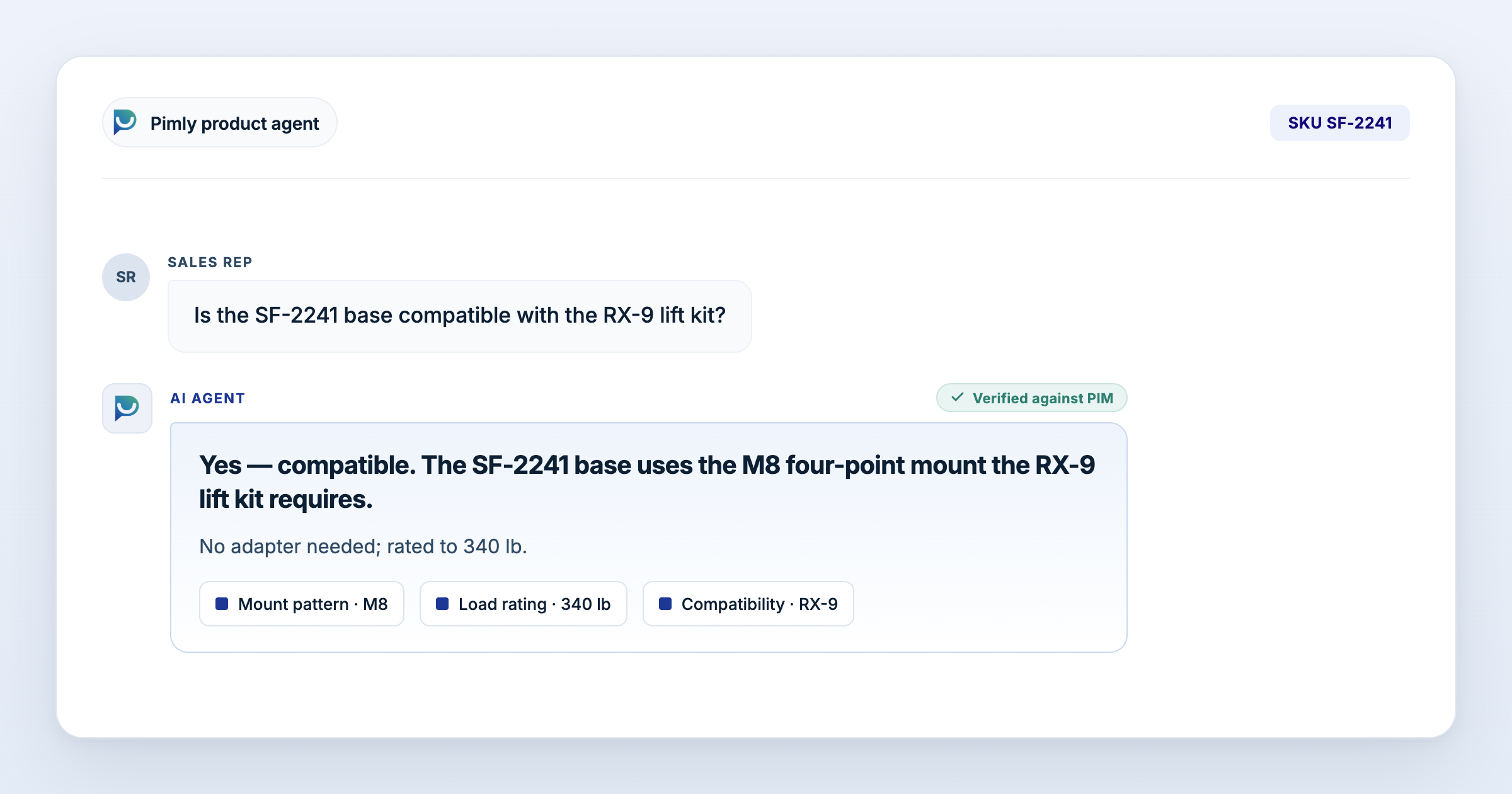
Here's the failure mode already sitting inside that gap. A sales rep opens Claude to prep for a renewal call. It drafts a sharp summary, flags the right stakeholders, surfaces the deal's real risk. Then the customer asks a product question — a configuration, a compatibility check, a spec comparison — and Claude either guesses from whatever fragment of product data it can reach, or it can't answer at all. This kind of question used to require a phone call to engineering for the answer, but today everyone knows the AI tooling is live, so why can't the rep answer the question live?
That gap matters differently depending on who's reading this. A Salesforce AE or SE selling the Claudeforce expansion needs to know precisely what the 37 skills do and don't cover before a prospect assumes more than what's shipping. A manufacturer or consumer goods company already running Sales Cloud, Service Cloud, and Agentforce needs to know whether its own product data will be ready the day Claude starts fielding product questions instead of just pipeline ones. Both questions have the same answer: governed product data isn't in the Claudeforce release.
Key takeaways
- Claudeforce ships 37 prebuilt sales skills today, covering pipeline, deal, and account workflows. None of them are product-facing.
- Reps and service agents get accurate, sourced answers to product questions only if the product data underneath is already structured and governed.
- Service, Marketing, Commerce, Revenue, Field Service, and several other Salesforce surfaces are publicly listed as "coming soon" with no committed date — that's the real window to get product data ready for Claudeforce to truly work with each of these endpoints.
- Analysts reviewing the rollout are already flagging that an AI reasoning layer is only as good as the CRM records it reads. Product data is a harder version of the same problem, and it's still ungoverned at most manufacturers and consumer goods companies.
Curious how ready your own product catalog is for the next wave of AI reasoning inside Salesforce? Try the free Product Data Grader and get your score in about a minute.
What Claudeforce actually ships today
Strip away the launch framing and Claudeforce is an expansion of what Agentforce can reason over, plus a new surface for reps to work in. The "Salesforce in Claude" plugin's initial 37 skills are all built for the seller's day-to-day motion — pipeline, deals, accounts, meetings — and all reason over Salesforce's core sales objects: accounts, contacts, opportunities, activities. None of them read a product catalog, a configuration rule, or a technical spec buried in a PDF manual.
Salesforce's own materials list Service, Marketing, Agentforce Commerce, Revenue, Field Service, and several data and integration products as "coming soon," without a date attached. That's a deliberate scope choice for a first release — but it means the product-facing skills a manufacturer or consumer goods company actually wants aren't part of September's open beta.
Governance runs on the rails Salesforce already had in place: Salesforce's official announcement is direct that Claude sees what the signed-in user is already authorized to see, and can do what that user is already authorized to do. Nothing about the new reasoning layer changes who's allowed to touch what — which also means it inherits every gap already sitting in the underlying data, product data included.
For Salesforce AEs and SEs: what the 37 skills actually mean
For Salesforce AEs who are trying to understand how Agentforce and Pimly's Salesforce-native product information management application work together, we frame it this way: "Agentforce is the voice, Pimly is the brain." Pimly's Product Intelligence functionality gives Agentforce a reliable response to deliver back to the end user about a product. Claudeforce doesn't replace that frame, it adds a second voice running on the same brain requirement. Claude now reasons inside Atlas, inside Agentforce Coworker, inside Agent Builder. The same governed-data dependency that was already true for Agentforce is now true for whatever Claude does on top of it.
That creates a real, immediate co-sell signal — arguably sharper than before. The moment a prospect asks whether the new Claude skills can already answer a configuration or compatibility question, an AE has two honest answers: not yet, on the currently shipping skill set — and here's what needs to be true before it can. Pimly Product Intelligence is built for exactly that gap: a native Salesforce layer that gives Agentforce, and now the Claude-powered reasoning behind it, accurate answers grounded in your product data for every team member — sales reps, service agents, ecommerce operators, marketers, and the agents acting on their behalf.
Let's be specific about the level of detail an AI layer needs to reason over to provide an accurate, reliable answer a rep can send back to a customer: whether a product is still available, whether it's approaching end of life, or which supplier and region it should be sourced from based on availability and margin.
For product-data and revenue-team leaders: the gap this creates
If you're the one managing product data at a manufacturer or consumer goods company already on Sales Cloud, Service Cloud, and Agentforce, the honest read is that you have a real runway. It's not an emergency yet, but the runway is finite. Claudeforce's product-facing skills don't exist yet, but they are "coming soon." The Pimly August newsletter already flagged the underlying risk this creates: an AI reasoning layer doesn't refuse to answer a question it can't fully support, it answers with incomplete information anyway, with the same confidence as a correct response.
That risk compounds for product data specifically. A CRM record has a handful of fields — a close date, a stage, an owner. A product catalog has thousands of SKUs, configuration rules, compatibility logic, and technical specs, often scattered across an ERP, a shared drive, or only partially reaching Salesforce through an external PIM integration. An incomplete integration means only part of that catalog reaches Salesforce, giving Agentforce — and any Claude skill built on top of it — incomplete context and unreliable answers on exactly the questions a rep or service agent can't afford to get wrong: does this part fit, is this configuration valid, what does this warranty actually cover.
The pattern analysts are already flagging
Coverage of Claudeforce's pilot has already surfaced the same warning from multiple directions: a reasoning layer amplifies whatever quality already exists in the records it reads. Stale close dates, duplicate accounts, and empty required fields get reasoned over anyway, and the answer looks exactly as confident as a correct one would. That's the readiness checklist Salesforce itself is pushing ahead of the open beta: audit accounts, contacts, opportunities, and activities now, before more of the org starts reasoning over them.
Product data is the same problem with higher stakes. Getting a pipeline forecast wrong is embarrassing. Telling a customer a part fits when it doesn't costs a service visit, a return, or the deal itself.
See what AI-ready product data looks like inside your own Salesforce org — book a demo.
Why governed product data is the actual prerequisite
An AI reasoning layer — Agentforce's Atlas engine, a Claude skill, whatever comes after either — doesn't need a second model bolted on top to get reliable at product questions. It needs one governed, structured, complete product record living inside the same Salesforce org it's already trusted to reason over. That's an architecture requirement, not a feature request, and it's the same requirement whether the reasoning layer is Agentforce alone or Agentforce running on Claude.
That's not an abstract requirement. The same SKU can mean something different depending on where it's being sold — a rep working one channel needs one set of pricing and compatibility rules, and the same product sold into a different channel or marketplace carries a completely different context. An AI reasoning layer has no way to tell those two situations apart unless the data underneath is already structured by channel, not just present somewhere in the org.
Pimly runs natively inside Salesforce with no external integration required. Pimly SmartSync distributes that governed catalog as configurations, not integration projects, to every endpoint that needs it: Agentforce Revenue Management (ARM), Agentforce Commerce, Sales Cloud, Service Cloud, and Experience Cloud. We even use the same SmartSync technology to ship your governed, structured product catalog to Shopify. SmartSync moves the governed data to where it's needed; Product Intelligence turns it into an answer a person or an agent can actually trust and deliver to a customer.
Cognex treats AI-agent reliability as a data-governance question, not a chatbot feature
Cognex's early adoption of Product Intelligence
Cognex Corporation, a Pimly customer since 2024, adopted Pimly Product Intelligence early specifically to get ahead of this problem. Diana Ferreira, Director of IT at Cognex, has pointed to centralizing product data as the reason her team expects faster resolution and more consistent guided selling — not a bet on a specific chatbot, but on one governed source any reasoning layer can draw from. That's the posture Claudeforce's own rollout rewards: get the data right before the reasoning layer asks a hard question of it. Internally, that same governed record is now being used to keep recommendations honest — steering reps and agents away from quoting products that are end of life or out of stock, rather than surfacing whatever looks like the closest match.
Get ready before Claudeforce asks the hard question
Whichever AI reasoning layer eventually gets asked a product question inside your Salesforce org — Agentforce today, a Claude-powered skill next quarter — the answer is only as good as the system of context that product record resides within underneath the AI layer. Getting that product information governed now, while Claudeforce's Service and Commerce skills are still "coming soon," means the day they ship, they inherit a source of truth that's actually ready for them. The result you can expect: every rep becomes a product expert — answering confidently, quoting accurately, and winning more deals.
Would you like Pimly to help you assess the AI readiness of your product data before Claudeforce's next wave of skills ships? Try the free grader.
Frequently asked questions
What is Claudeforce?
Claudeforce is the expanded partnership between Salesforce and Anthropic, announced August 26, 2026, that puts Claude's reasoning behind Agentforce and gives sales reps a plugin to work with Salesforce data directly inside Claude. It has two parts: "Claude in Salesforce," which runs Claude as the reasoning model behind Agentforce's Atlas engine, Vibes, Coworker, and Agent Builder, and "Salesforce in Claude," a plugin bringing 37 prebuilt sales skills and governed Salesforce data access into Claude's own interface. Both are in pilot with select customers now, with a broader beta expected in September 2026.
How many skills does the Salesforce in Claude plugin actually include?
The plugin ships with 37 prebuilt sales skills at launch. Only about half of the 37 have been individually named so far, covering things like daily briefings, pipeline review, deal health checks, account planning, and meeting prep, with the rest grouped into the same handful of clusters. A complete, itemized list of all 37 hasn't been published yet.
Does Claudeforce include product data or catalog capabilities yet?
No. The 37 skills shipping today reason over Salesforce's core sales objects — accounts, contacts, opportunities, and activities — not a product catalog, configuration rules, or technical specs. Service, Marketing, Agentforce Commerce, Revenue, and several other Salesforce surfaces are listed as "coming soon" without a committed date, and product data specifically hasn't been named as part of any near-term release. That's the window to get a product catalog governed before Claude is asked to reason over it.
Why isn't fixing CRM hygiene alone enough to make an AI reasoning layer reliable for product questions?
CRM records like close dates, account status, and activity logs are a handful of fields per object, and cleaning them up is a real but bounded exercise. Product data is a much larger challenge — thousands of SKUs, configuration rules, compatibility logic, and specs that are often scattered across an ERP, a shared drive, or only partially reaching Salesforce through an external PIM integration. An AI reasoning layer doesn't know the difference between a governed answer and a guess; it delivers both with the same confidence, so the size and mess of the underlying product catalog determines how often that guess is wrong.
How does Pimly prepare a Salesforce org for Claudeforce's future product-facing skills?
Pimly runs natively inside Salesforce, with no integration required, and centralizes product data as one governed catalog instead of scattered exports. SmartSync then distributes that catalog as configurations — not integration projects — to Agentforce Revenue Management, Agentforce Commerce, Sales Cloud, and Service Cloud, so it's already living where Agentforce, and any Claude-powered skill built on top of it, already looks for answers. Pimly Product Intelligence turns that governed record into accurate answers grounded in real product data for every team member, so when Claudeforce's product-facing skills do ship, they're reasoning over a catalog that's ready for them.