What Does AI-Ready Product Data Do for Your Revenue Team?
.svg)
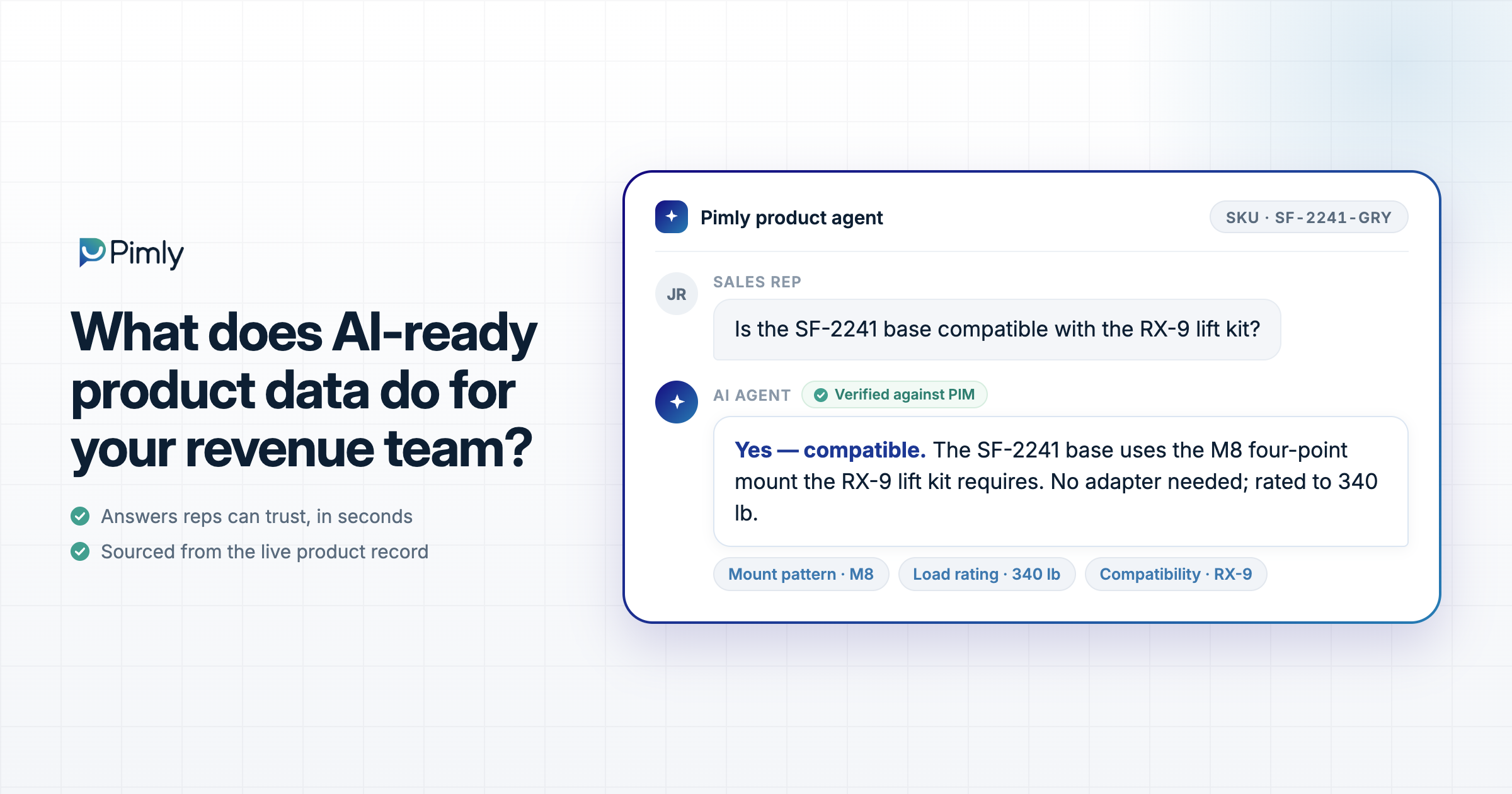
Ask a sales rep and a service agent the same product question today, and how often do you get two different answers? That's the test that actually matters for revenue teams running AI-assisted selling and service inside Salesforce — not whether Agentforce can generate a response, but whether every rep and every system generates a response that's actually accurate, grounded in the same governed product record.
AI-ready product data means every SKU, attribute, and configuration rule lives in one governed record that Agentforce Revenue Management (ARM), Sales Cloud, Service Cloud, and Agentforce all read from — not five different exports of the same catalog. It's accurate, complete, structured, and well-governed enough for AI to use without a human checking the work first.
Here's what happens without it: a field service rep pulls a spec sheet from a shared drive that's two revisions old. An inside sales rep quotes a bundle configuration that manufacturing retired last quarter. Agentforce answers a customer's product question by drawing on whichever record it can find — accurate or not — and hands the rep a promise the business can't keep.
For a VP of Sales Ops or VP of RevOps rolling out AI-assisted selling, this is the gap between a pilot that looks good in a demo and a rollout reps actually trust with real quotes and real customers. Getting product data AI-ready isn't a technical nice-to-have — it's the difference between an AI-assisted selling motion that works as promised and one that quietly erodes trust every time it's wrong.
Key takeaways
- Sales reps and service agents each get an accurate product answer grounded in the same governed data — no toggling between systems, no double-checking what Agentforce just told a customer.
- Reliable beats guesswork: governed product data gives every rep a trustworthy, accurate answer grounded in the same record, instead of an answer that drifts depending on which export or system it came from.
- GE Vernova saw a 5x cross-sell lift after unifying roughly 200,000 SKUs in Pimly; Darley reached payback on its Pimly implementation within 9 months of go-live.
- Structured, governed product data is the foundation ARM, Sales Cloud, Service Cloud, and Agentforce all need — without it, no AI-assisted selling motion holds up past the demo.
- Pimly gets there in three steps: pull product data in from ERP, PLM, and spreadsheets; organize it into one governed record; distribute it to every Salesforce cloud that needs it — no integration required.
Would you like Pimly to help you assess the AI readiness of your own product data? Try the free Product Data Grader — it takes about a minute and comes back with a complimentary report.
What problems come from sales and service teams working off different product data?
Shadow systems are the tell. When a field service rep keeps a personal spec-sheet folder, when an inside sales rep maintains a product cheat-sheet in a spreadsheet, when an account exec calls the product team to confirm a configuration before sending a quote — that's not a training gap. It's a signal that the product data foundation underneath Sales Cloud and Service Cloud isn't accurate or complete enough for reps to trust on its own.
The downstream cost compounds. A rep who quotes an outdated configuration doesn't just lose that deal — they lose the customer's confidence that the next quote will be right either. A service agent working from different specs than the sales team that sold the deal escalates cases that shouldn't need escalation. And every AI-assisted motion Agentforce runs on top of that fragmented data inherits the same inconsistency, just faster and at a bigger scale. Pimly's guide to product data challenges inside Salesforce breaks down exactly where these gaps tend to open up.
Ask this: can your service agents answer a product configuration question without opening a second tab or pinging sales? If the answer is no, the gap isn't in Agentforce — it's in the product information feeding it.
How do field service and inside sales teams get accurate product specs in real time inside Salesforce?
They get it the same way Sales Cloud and Service Cloud get any other record: from inside Salesforce, in real time, with no separate system to check. The Pimly Product Data Layer (PIM) runs natively on Salesforce, so the same governed SKU, attribute, and bundle record that ARM uses to quote is the record a field service rep sees on a work order, and the record Agentforce reads when a customer asks a product question through a self-service channel.
That's a meaningfully different answer than "connect your PIM to Salesforce." No integration required, no sync delay, no subset of fields making it across while the rest stays behind in a disconnected system. Product data lives inside the platform Agentforce, ARM, Sales Cloud, and Service Cloud already query — which is why Pimly surfaces the same governed product data across ARM, Commerce, Sales, and Service clouds without reps ever needing to know which system holds the real source of truth. Salesforce's own Agentforce rollout guidance makes the same point from the implementation side: connecting product information correctly is the step that determines whether the rollout succeeds.
Why does reliable product data matter more than another AI feature?
Ask a general-purpose AI tool the same product question five times and the answers can drift — fine for drafting an email, not for quoting a six-figure deal. Ask governed product data the same question inside Salesforce and every rep gets an answer that's accurate and grounded in the same record, because the underlying data didn't change between asks. That's the reliable, trustworthy standard revenue teams actually need from AI-assisted selling.
Salesforce's own research backs this up. In a Valoir study of Agentforce deployments, customers who tried to build their own AI grounding saw accuracy plateau around 50-60%, while the same customers running Agentforce grounded in trusted, governed data reached 91% accuracy or higher. The gap wasn't the AI model — it was whether the data underneath it could be trusted to hold still.
For a VP of RevOps deciding where AI-assisted selling is actually ready to scale past a pilot, that's the real test: not whether Agentforce can generate a plausible-sounding quote, but whether it generates an accurate quote every time, with product and configuration data structured, complete, and governed well enough that no human needs to check the work first. Why Salesforce Agentforce needs product intelligence goes deeper on what that grounding actually requires.
Curious where your own product data lands on that scale? Try our Free Product Data Grader to find out in about a minute.
How does Pimly make product data AI-ready across Salesforce?
Getting there doesn't require a phased rollout or a separate platform to maintain. Pimly gets product data AI-ready in three steps: pull it in from ERP, PLM, shared drives, and spreadsheets; organize it into one governed record inside Salesforce; then distribute it to every cloud and every AI agent that needs it — ARM, Agentforce Commerce, Sales Cloud, Service Cloud, and Agentforce itself.
SmartSync keeps that record current across every Salesforce configuration a revenue team relies on — not integration projects, just configurations inside Pimly that keep ARM's product catalog, Sales Cloud, and Service Cloud all reading from the same governed source. Pimly/SmartSync gives ARM the current, accurate product and configuration data it needs to quote correctly; pricing rules and rates stay exactly where they belong, managed in ARM.
That boundary matters because ARM's product catalog, while more capable than Product2 (the core Sales Cloud and Service Cloud product record), still hits a ceiling for manufacturers running complex bundles, multi-market configurations, and locale-specific attributes. Pimly Product Intelligence is the layer above both — the one place that gives every cloud, and every AI agent reading from it, the same accurate, complete, structured, and well-governed product record.
What results have revenue teams seen from AI-ready product data?
GE Vernova's 5x cross-sell lift
GE Vernova unified roughly 200,000 SKUs inside Pimly, replacing disconnected spreadsheets and manual updates with one governed record across its B2B Commerce platform — about half of GE Vernova's business runs through it today. Cross-sell improved 5x following implementation. Read GE Vernova's full story on Salesforce AppExchange.
Darley's 9-month payback
Darley, a manufacturer with more than a century serving first responders and the military, reached payback on its Pimly implementation within 9 months of go-live. "With Pimly, Salesforce is now our Center-of-Truth for Sales, Product, and eCommerce," says Kim Brown, Chief Marketing Officer at Darley — a result that shows up directly in how fast reps and service agents can trust a quote or a spec without checking a second system.
What's the outcome of AI-ready product data for your revenue team?
None of this is about giving Agentforce another feature. It's about giving sales reps and service agents a foundation they can trust without double-checking — accurate, complete, structured, and governed well enough that AI-assisted selling works the way it's supposed to, the first time and every time.
The result: every rep becomes a product expert — answering confidently, quoting accurately, and winning more deals.
See what AI-ready product data looks like inside your own Salesforce org — book a demo.
Frequently asked questions
What does "AI-ready" product data mean?
AI-ready product data is accurate, complete, structured, and governed well enough that an AI agent can use it without a human checking the work first. That's a higher bar than "AI-enabled," which just means an AI tool has access to the data — access alone doesn't guarantee the data is trustworthy. For a revenue team, AI-ready means Agentforce, ARM, Sales Cloud, and Service Cloud can all quote, answer, and resolve from the same governed record without a rep double-checking the output.
What makes product data ready for Agentforce and ARM?
Product data is ready for Agentforce and ARM when every SKU, attribute, bundle rule, and configuration lives in one governed record instead of scattered across ERP exports, spreadsheets, and shared drives. That record needs to be structured — organized into consistent fields an AI agent can parse — not just accurate in a spreadsheet a person can read. When that record is in place, ARM can quote correctly and Agentforce can answer a product question without guessing at missing context.
How is AI-ready product data different from AI-enabled product data?
AI-enabled just means an AI tool has been pointed at the data; AI-ready means the data itself is accurate, complete, structured, and governed enough that the AI tool's output can be trusted without review. A company can be AI-enabled — Agentforce is turned on — while still getting inconsistent answers because the underlying product records are incomplete or scattered across systems. AI-ready is the data-quality bar that makes AI-enabled tools actually reliable for reps and customers.
Why isn't a spreadsheet or a general PIM enough for AI-assisted selling?
A spreadsheet has no governance layer, no structure an AI agent can reliably parse, and no way to guarantee every rep is looking at the same version. External PIMs built outside Salesforce face a related problem: even when the integration works, it often syncs only a subset of product data into Salesforce, leaving Agentforce and ARM with incomplete context and producing unreliable outputs. Pimly avoids both failure modes by running natively inside Salesforce, so there's no export, no subset, and no separate system to keep in sync.
How does a PIM help sales reps and service agents specifically?
A Salesforce-native PIM gives sales reps and service agents one governed product record to work from instead of five different exports of the same catalog, so a quote or a spec answer is accurate no matter who pulls it or which system they're in, because everyone is reading from the same governed record. That consistency is what lets Agentforce answer product questions with a rep's own data instead of guessing. The result is fewer escalations, fewer re-quoted deals, and reps who can answer product questions with the same confidence as the product team.